
Prologue
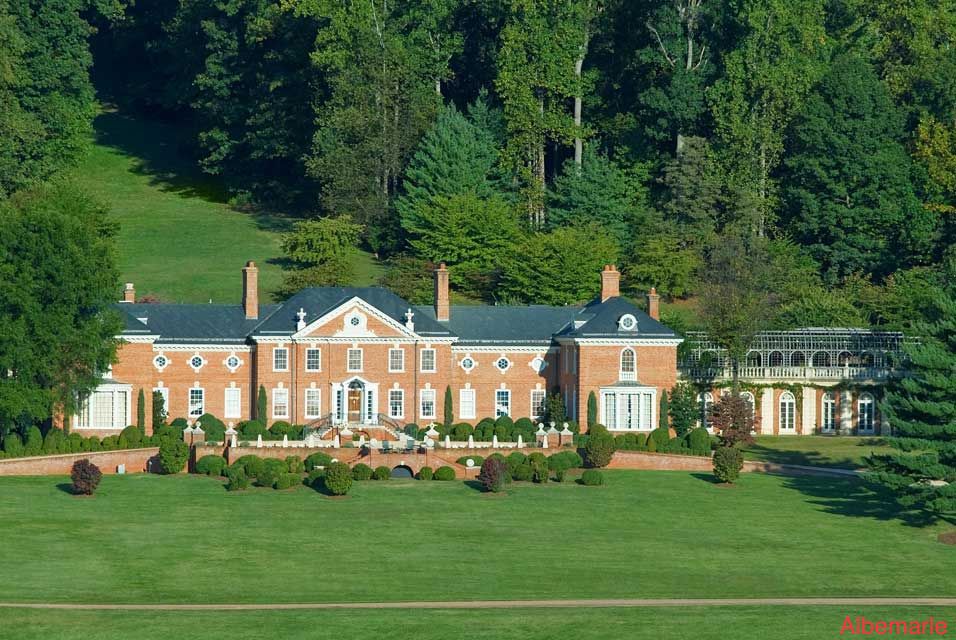
This handsome 23,000 sf Georgian revival mansion is known as Albemarle (AL-bi-marl) House and is sited on a 990 acre estate south of Charlottesville, VA (which is located in Albemarle County). It was designed by David Easton, a New York-based architect and designer (who also designed Twin Maples in Connecticut), and completed in 1985 for newlyweds, John and Patricia Kluge. Albemarle House was the innocent witness to a classical tragedy involving insatiable ambitions, degeneracy, avarice, catastrophic falls, and maybe some lessons learned (but probably not). Our story unfolds thusly…..
Act I – The Catholic School Girl
Patricia Kluge (nee Rose) was born in Iraq in 1948 to British parents and was educated in a convent school in Baghdad. After her parents split up in 1963, her father moved to London and sixteen year old Patricia followed a year later to live with him. Unfortunately, Patricia’s father had already moved in with another woman and Patricia was not welcome. Patricia stayed on in London, took a series of odd jobs and lived with friends. One night, while working as a hat check girl at a Turkish nightclub, she filled in for the belly dancer who was out sick. In the audience that night was a soft-core porn publisher named Russell Gay. Mr. Gay, who was 32 years older than Patricia, took a shine to her and they moved in together and eventually married in 1973. The catholic school girl from Baghdad was a regular model for Mr. Gay’s porn publications and wrote a sex advice column for his magazine, Knave. She also took a crack at acting but her only credit is as “The Dancer” in the 1969 erotic comedy The Nine Ages of Nakedness (IMDB rating 4.7 out of 10). Eventually, Patricia grew restless with her skeevy life in London and longed for some place that was simpler, quieter and with more traditional values. So she divorced Mr. Gay in 1976, packed up her things and moved to New York City.

Act II – The Rise
Soon after arriving in New York, Patricia met John Kluge who was 35 years her senior. John Kluge was a German immigrant who worked his way up from a Ford assembly line to extraordinary business success. His company, Metromedia, at one time owned 14 television stations and 22 radio stations. He sold off the stations in 1986 and they eventually became the core of what is now known as the Fox Network. At the time, Kluge was regarded as the richest person in the U.S. with a fortune of $5.2 billion (nowadays this doesn’t even crack the top 200). John was immediately smitten by the 5’10” beauty when she invited him to a dinner party and then, when the dishes were cleared, started belly dancing on the table. John would later recall of this moment “Where had I been all my life??” For her part, Patricia phoned a friend in London and blurted “I’ve met a guy who’s stone rich!!” John soon ditched wife #2 and, after living with Patricia for a couple years, they married in 1981 in a huge wedding at St. Patricks Cathedral on New York’s Fifth Avenue. They then started building their dream home, Albemarle. They did not live happily ever after.
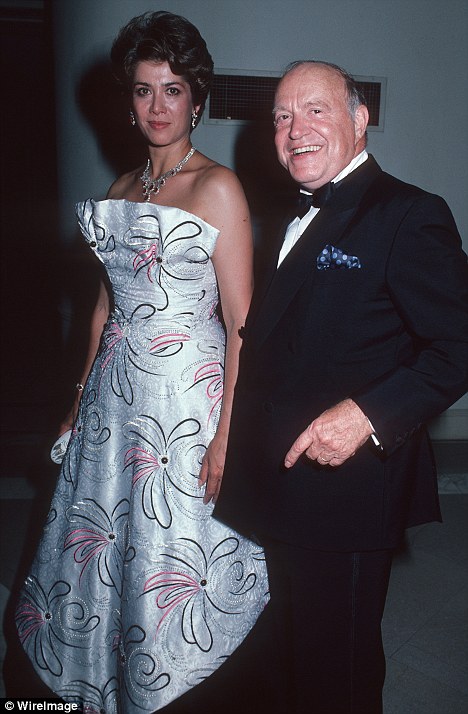
Marriage counselors will often tell you that you should work on the relationship rather than the house. Alas, John and Patricia did not heed this advice. They were only in Albemarle for five years but during that time the house was the social center of Virginia and the Kluges hosted Frank Sinatra, King Juan Carlos of Spain, the ex-King Constantine of Greece, Tony Bennett and other A-listers. Sadly, their love (or whatever it was) soon faded and they split up in 1990. In a move that would later prove calamitous, Patricia got the house in the divorce but John kept the land in front of the house including his beloved private golf course. Despite this proximity, they went their separate ways. Patricia married for a third time to William Moses, a retired IBM executive, and John married for a fourth time to Maria Kuttner, a holistic health practitioner (who was also 35 years his junior).

Act III – The Precipice and the Fall
In the late 1990s, Patricia and William developed vineyards and a winery on the property which has won several awards for the quality of the wines. In 2007, Patricia started taking out mortgages on Albemarle to expand the winery business and to develop a 24 lot luxury subdivision on the property called Vineyard Estates (you see where this is going, right?). The timing was terrible as the 2008 financial crisis hit soon afterward wiping out the demand for the luxury homes (only a model home was built on the subdivision). In addition, the winery expansion was cranking out 30,000 cases a year but only a third of that was actually sold. Patricia and William started falling behind on the payments on $35 million in loans. Patricia realized she was in trouble and tried to bail out, listing Albemarle in 2009 for $100 million. Unfortunately, there wasn’t a market for Albemarle House either and the price was dropped to $48 million and then to $24 million but the house still sat unsold. Patricia then auctioned off the contents of the house in 2010 raising $15 million to keep the banks at bay. John Kluge, Patricia’s ex, died that same year at age 95. Towards the end of 2010 the banks moved in and starting foreclosing on the winery assets and the failed subdivision. In 2011, it went from bad to worse for Patricia. First, Bank of America foreclosed on Albemarle house itself and Patricia had to move out of her dream home and into the model home of the subdivision project. By June she had declared bankruptcy listing $3 million in assets and $48 million in liabilities. Patricia was hitting rock bottom. But a potential savior was out there. Watching all this happen. And Waiting.

Act IV – The Leader of the Free World
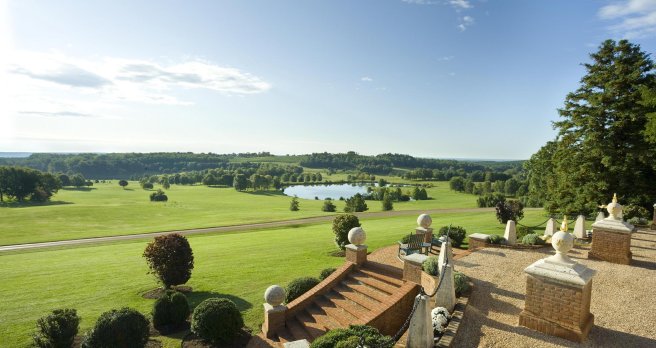
Donald Trump was a friend of the Kluges, a Manhattan real estate developer, casino impresario, golf course developer, online college president and a reality TV star. Later in life he would also become the leader of the free world but before all of that he had developed a liking for Albemarle. This is when the decision to split the house and the front yard in the divorce came back to haunt Patricia. By this time, the golf course and the front yard was under the control of John Kluge’s heir, John Kluge Jr. Mr. Trump cut a deal with Kluge Jr. to buy the golf course and Albemarle’s front yard for a half million dollars. Bank of America, looking to unload Albemarle house itself, put it up for auction. Mr. Trump put in the high bid of $3.6 million but the bank still rejected it as too low. Now, Mr. Trump was not a man to be easily deterred. Used to getting what he wanted (*COUGH* except for reelection), Mr. Trump bought the 776 acre vineyard out of foreclosure for $6.2 million. He now owned everything except the house itself (which the Bank of America was pitching for $16 million). His next move was to stop mowing the lawns. The grass around Albemarle house grew long and unkempt. Weeds sprouted. The curb appeal waned. The future global statesman then posted “NO TRESPASSING” signs all around his part of the property and posted security guards casting a pall on prospective buyers who the bank’s realtors would shepherd around the property. Sensing that a grave injustice was being committed, Bank of America brought suit against Mr. Trump in the Albemarle County Circuit Court in Charlottesville. Lawyers were dispatched. Declarations were submitted. Cease and desist orders were proposed. Finally, in 2012, the Bank of America, exhausted from fighting the injuries allegedly perpetrated by Mr. Trump, agreed to sell Albemarle House to him for $7 million writing off $16 million in defaulted loans to Patricia Kluge Moses. More litigation then erupted over Mr. Trump’s unpaid legal bills, late payments to John Kluge Jr., and contested conservation easements on the Albemarle estate. Virginia would not know peace again until 2013.
Epilogue
In the story of Albemarle House no one lived happily ever after. Patricia Kluge Moses, relieved of her crushing financial obligations said “My worst nightmare and personal armageddon are over.” She still lives in the model home of her one-time luxury subdivision. None of the other homes were built. Donald Trump, the humble public servant, dedicated himself to four years of public administration but eventually he was also evicted from his grand palace in Washington D.C. Today he lives in exile in Florida. John Kluge is dead. So is the English porn publisher, Russell Gay. It’s debatable if any of the main characters of this tragedy are any wiser. However, Albemarle House, the innocent witness to this tale of tragedy, has found a new life. In 2012, the Trump Organization began the process of converting the empty, neglected and decaying Albemarle mansion into a bed & breakfast and building a separate wedding venue that started welcoming guests in 2015. The vineyard and winery started by Patricia Kluge still operates under Trump ownership and annually sells 20,000 cases of wine in addition to Trump-branded golf shirts and accessories. As one final twist to this story, Albemarle may be the only winery in the world that is owned by someone who doesn’t drink alcohol.

Afterword
If you want to stay at Albemarle or just drop by and sample some wine (which is supposed to be excellent) then click here for more info. Other than that, Albemarle House itself is not open to the public.
Authors Note: Obviously most people either love or loathe Donald Trump. This blog is not about politics but about architecture, beautiful country houses and the people who lived in them (for better or worse). Mr. Trump just happened to step into the line of fire in this case when he bought Albemarle and he was then exploited for his entertaining personality and colorful business practices. So I blame him. My apologies to anyone who was offended by this exploitation.
 North American Country Estates
You could have left politics and your personal opinion out of this and it would have been an excellent article, instead, you went where you shouldn’t have gone… shameful
LikeLike
You misinterpreted this post. In any classical tragedy all the characters are flawed, even the heroes. I can’t be faulted for pointing out the all to human weaknesses and personal vanities and excesses of the main characters. And, as in most classical tragedies, things end badly for everyone so the tale of Albemarle pretty much stays on script. If there is any redemption at all it is that the house survived and thrived in the end which is how it should be in any blog about great houses – Ed
LikeLike