
The Vanderbilt family is famous for incalculable wealth, gilded age mansions, blue jeans and Anderson Cooper. Many fans of gilded age mansions know about those that were built by members of the Vanderbilt clan such as the Biltmore Estate in North Carolina (click here for more on Biltmore), The Breakers in Newport, RI or Hyde Park in New York (click here for more on Hyde Park). Most people assume that the Vanderbilt mansions have long since been converted into museums and that the Vanderbilt descendants now live like the rest of us mere mortals. Although some Vanderbilt descendants have done well in business, the arts or academia or are minor members of the English aristocracy others lead decidedly middle class lives.
The Vanderbilt fortune that was built up in the 19th century through astute investments in steamships and railroads has been so diluted through inheritance and multiple divorces or squandered on fine living throughout the decades that most contemporary Vanderbilts are merely comfortable, not filthy rich. By way of example, one of the bigger chunks of contemporary Vanderbilt money is in the hands of someone with no Vanderbilt blood at all (and potentially has never even met a Vanderbilt). A certain John Hendrickson had been working as a government official in Alaska and living in a two-bedroom condo in Anchorage when he met and married former actress and horse breeder Marylou Whitney. Marylou, in turn, had previously been the fourth and final wife of Cornelius Vanderbilt Whitney and inherited $100 million when C.V. died in 1992. When Marylou (who was 40 years older than John) died in 2019, the former Alaska government employee inherited her fortune.
Due to these sorts of twists and turns, contemporary Vanderbilts mostly live in nice, but unremarkable homes. But there are a few exceptions. One truly notable exception is the home of James Spencer-Churchill, the 12th Duke of Marlborough and great grandson of the famously reluctant bride, Consuelo Vanderbilt. The Duke owns (and sometimes even lives in) England’s Blenheim Palace, which is almost twice as large, and also twice as nice, as the Biltmore Estate. For more on Biltmore, click here. On this side of the Atlantic sits a more down-to-earth exception known as High Lawn, nestled in the Berkshire Mountains near Lee, Massachusetts.
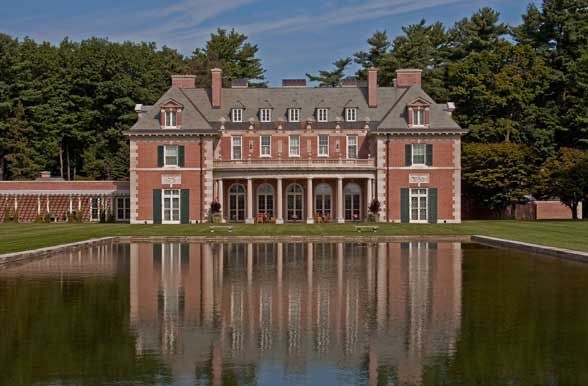
High Lawn started off in 1870 as a farm and summer home for breeding trotting horses developed by Elizur Smith, a local paper manufacturer and politician. Around 1885 a portion of the farm was sold to Emily Thorn Vanderbilt, a grand daughter of Cornelius Vanderbilt, and her husband William Douglas Sloane. The Sloane-Vanderbilts parceled off a portion of their estate and gave it to their daughter, Lila Vanderbilt Sloane, on occasion of her wedding to William Osgood Field in 1902. The house was designed by the New York architectural firm of Delano and Aldrich and completed in 1910. It is 25,000 square feet and sits on a 1,600 acre estate. The bas-relief sculptures above the French doors in each bay of the facade were created by Lila’s cousin, Gertrude Vanderbilt Whitney. Along with the pleasing proportions, red brick, dormers and the limestone quoins, High Lawn is a striking example of Georgian revival house design. I only have one quibble: would it have killed the architect or the builder to match the chimneys visible from the front?

Cornelius Vanderbilt was known as “The Commodore” and at one time was the richest person in the United States. Cornelius started off with a single sail boat ferrying passengers between Staten Island and Manhattan, built a fleet of steamships and eventually ended up with a railroad empire with the New York Central Railroad as the centerpiece. Known to his contemporaries as crude, brutal and vulgar and barely literate, Cornelius nevertheless was a brilliant business innovator and built up a fortune that would be worth $200 billion in today’s dollars, on par with Jeff Bezos or Bill Gates. BTW, in fairness to old Corny, most of his competitors back in the day were also crude, brutal and vulgar.

Lila and William used High Lawn as a vacation home and upon Lila’s death in 1934, the property was purchased from Lila’s estate by her daughter, Marjorie Field. Marjorie and her husband, H. George Wilde, developed a dairy farm business on the property, High Lawn Farm, that has become internationally renown for breeding high quality jersey cows. The farm is still in operation to this day and can be visited by the public although High Lawn House is still a private home and not open to the public nor is the house visible from the dairy or any public road. If you do visit the dairy, stop by the store and try their purple cow milk shake.

Marjorie passed away in 1997 and the estate and farm came under the control of her son, George William “Bill” Wilde, a great great great grandchild of The Commodore. Bill, who passed away in 2013, was a graduate of Princeton and the Harvard Business School, served in the U.S. Marine Corps and was an investor in addition to being in the dairy business. Presumably, High Lawn is now controlled by his widow and heirs.

High Lawn lives on as one of the few (and probably the only) “Vanderbilt mansion” that is still lived in by a Vanderbilt, going on 115 years of continuous family ownership (140 years if you count ownership of the land).
Just one mile north of High Lawn is another beautiful country house, The Mount, which is covered in this blog (click here for more).


 North American Country Estates
I think my mother was a nanny/caretaker here from around 1948-1950’s. She came to visit her Aunt Alma. My mother came from Finland in 1948. Her name was Clara Ekstrom. If you have any photos from this time, I would LOVE to see them. Thank you, Doug Nelson
LikeLike
Hi Doug, I don’t have any photos from that time period. There are not many photos of High Lawn in the public domain at all. For such a stunning home it’s not well known.
LikeLike