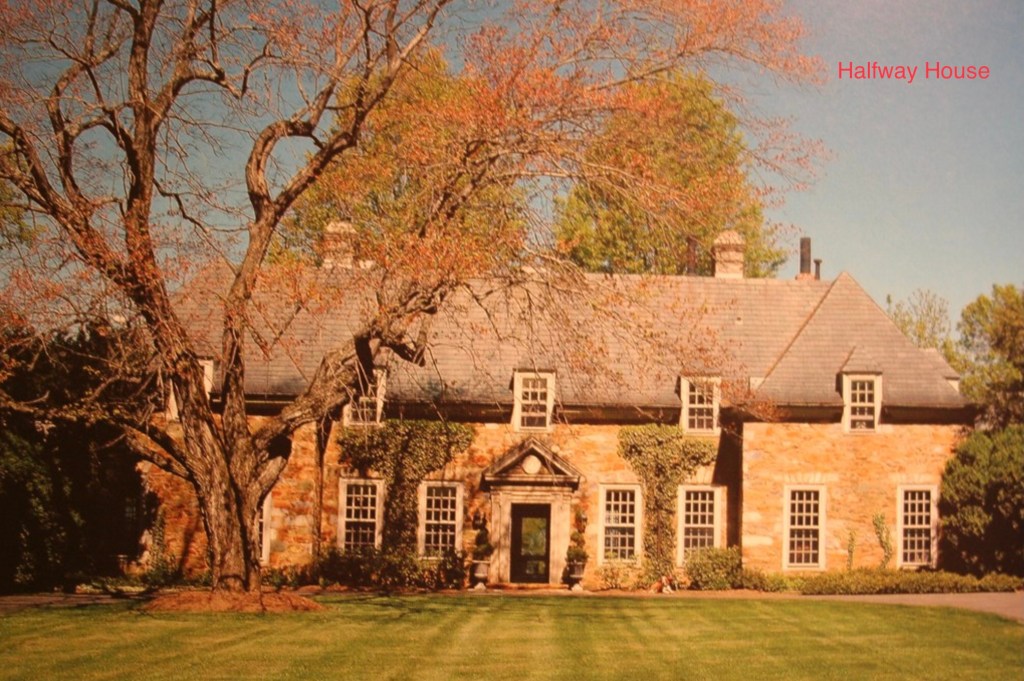
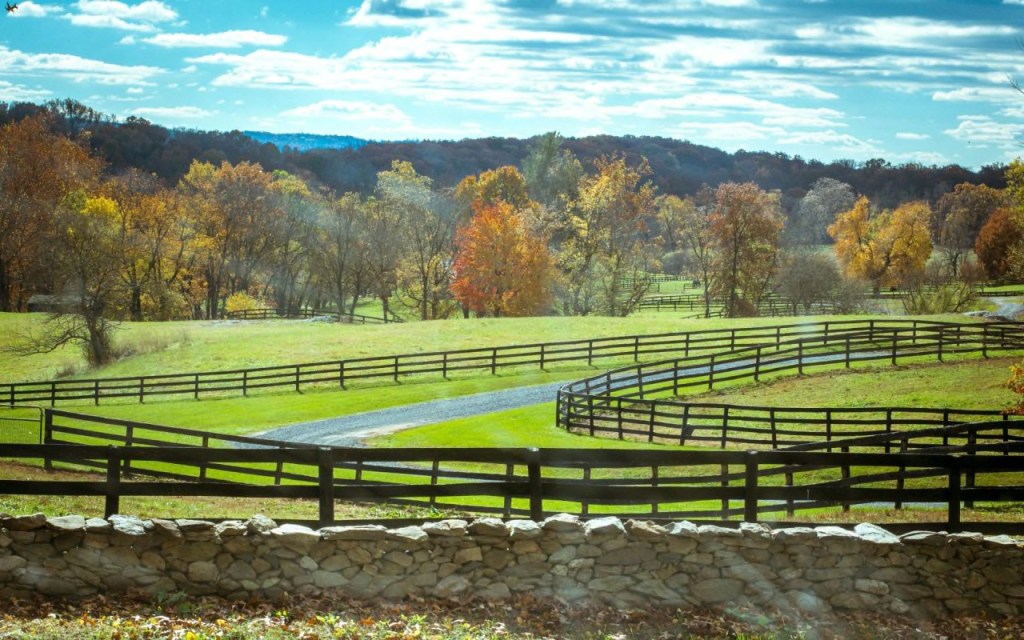
This is Halfway House which is conveniently located half way between Middleburg and The Plains in the Virginia Hunt Country west of Washington D.C. Halfway House was completed in 1934 to a design by William Bottomley, a Virginia-based architect who is responsible for many of the handsome Georgian-revival houses that grace the State (including Rose Hill and Chilton). Halfway House sits on a 571 acre estate and was built by James and Vira Whitehouse who also had homes in Newport, RI and New York City. James was a stockbroker and Vira was a suffragette and political activist. Today, Halfway House is owned by a former AOL Vice President named John Ayers and is now referred to as High Meadows Farm and is used for raising grass-fed cattle.
Design concept of Halfway House
The Virginia Hunt Country is famous as a country retreat for 1 percenters, horse farms, fox hunting and fine gardens. Just two miles west of Halfway House is another country estate covered in this blog, Wayside Manor (click here for more info). For more about the Virginia Hunt Country, click here.
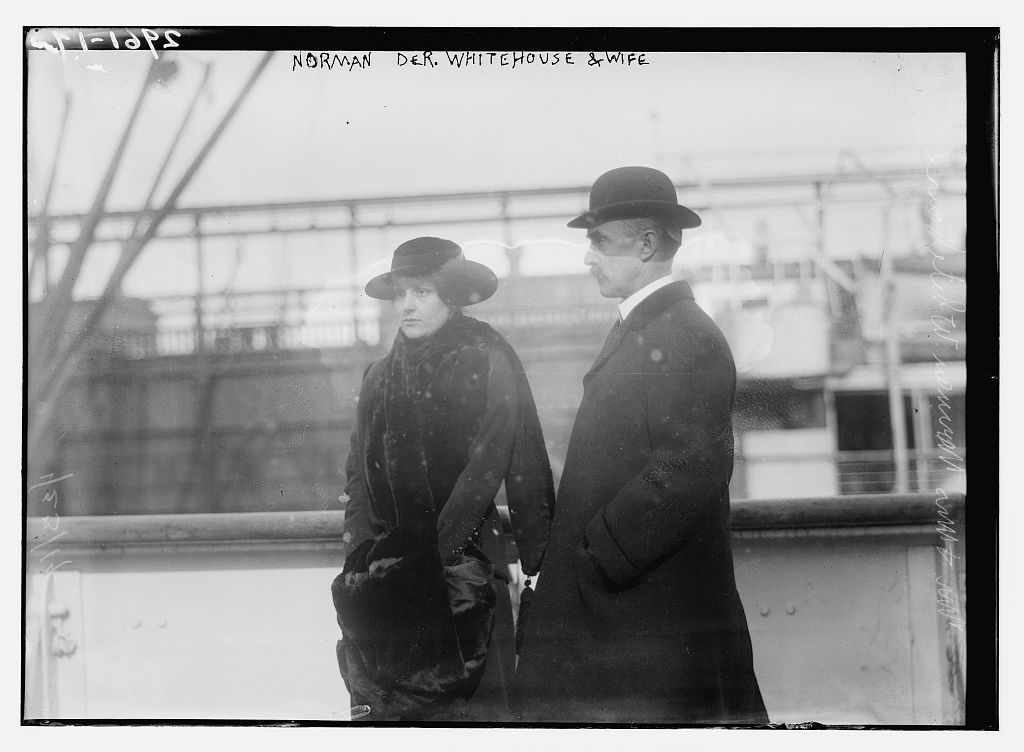
James and Vera Whitehouse, the builders of Halfway House
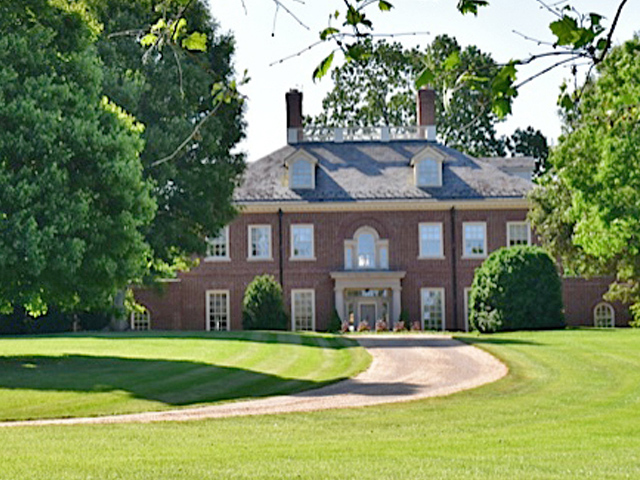
This is the 11,000 square foot Huntley Hall located near the hamlet of Broad Run in Fauquier County, Virginia. Huntley hall anchors a 4,000 acre estate composed of working farms, rolling pastures, park-like landscaping and small lakes. The Georgian style manor house was built in 1987 to a design by the Philadelphia-based architect, Tony Atkin. The proprietors of this enterprise are John and Anne Hazel. John Hazel’s resume includes a law degree from Harvard University, a stint as a Judge Advocate General in the Army, another brief stint as a Circuit Court judge in Fairfax County, Virginia and a partner in a 118-person law firm specializing in property and zoning law. It was this latter experience that provided the basis for a 40 year career in land development in northern Virginia where John Hazel was the key developer in major projects such as Tysons Corner and Fairfax Station. Mr. Hazel has also served on the boards of the National Air and Space Museum and the Corcoran Gallery of Art in Washington D.C. Huntley Hall is a private home and is not open to the public.
Garden front of Huntley HallEntrance frontlandscape sceneEntrance drive
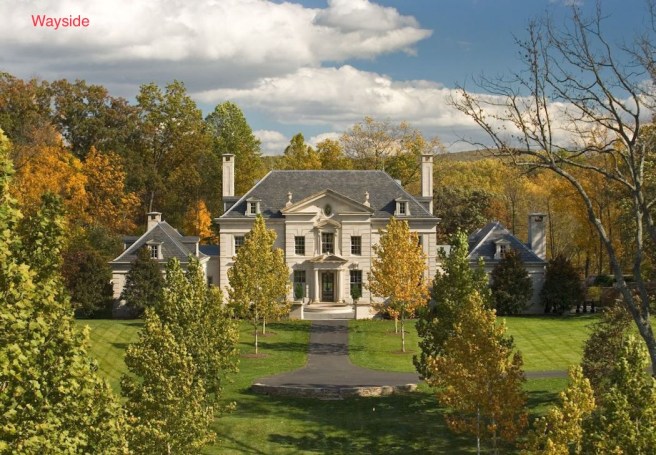
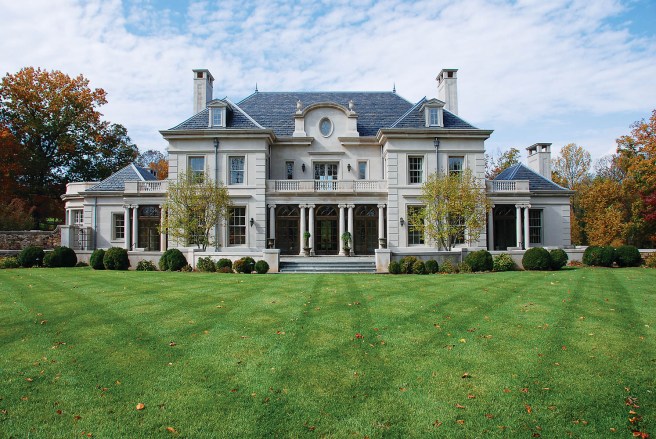
This is Wayside Manor, a 17,000 square foot neo-classical/palladian house completed in 2005 and sited on 100 acres in the Virginia Hunt Country near Middleburg, VA. The house and landscaping was designed by the Washington D.C.-based firm of Franck & Lohsen. The property is owned by a D.C.-based developer who has built many office buildings for lobbying groups and associations over the years. The clients are big art collectors and lent their collection to the National Gallery of Art for exhibition while the house was being constructed.
If I’d been the client I would have gone with a different paving surface than asphalt (crushed rock?) and hidden the garages away but otherwise this is a great example of the New Classicism movement in residential architecture that started in Europe in the late 20th century after modernist and post-modernist schools ran their course. In the United States, interest in classical architecture was renewed in response to the destruction of classically-designed structures like New York City’s Pennsylvania Station. You don’t know what you’ve got until it’s gone when it comes to iconic buildings. Many architects on both sides of the Atlantic such as Quinlan Terry in the UK and Allan Greenberg in the US have pioneered a new appreciation and appetite for classically-designed houses that are every bit as fetching as the iconic country houses from the 17th or 18th centuries.
Just two miles east of Wayside is another interesting country house, Half Way House, covered in this blog (click here). Also, if you want to learn more about the Virginia Hunt Country and how they preserve its rural character, click here. Wayside Manor is a private home and not open to the public.
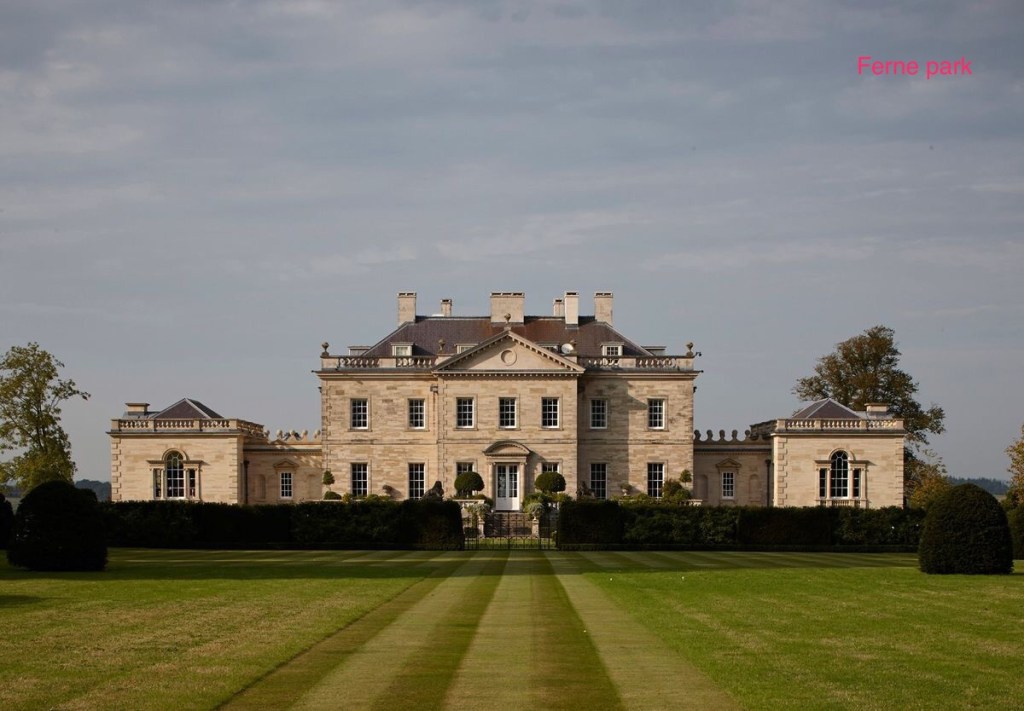
Ferne Park in Wiltshire, England. A great example of the new classicism trend in residential architecture (for those that can afford it). Designed by British architect, Quinlan Terry, the house was built in 2001 and may be the most impressive country house built in the world in the last half century.
While satisfying to look at and an essential part of our architectural heritage, most of the houses and estates in this blog are a bit archaic in the 21st century. They don’t really fit into the notion of an egalitarian, democratic country with a big middle class that prides itself on equal opportunity. In the age of the subdivision, how does one have a 300 acre estate in an easy going, bucolic area such as the Virginia Piedmont, the Berkshires or the Hudson River valley without getting eaten alive by property taxes? How do large country estates survive in the 21st century? This is a real dilemma in the United States where, with customary American efficiency, land is typically taxed at a value commensurate with its “highest and best use” which usually doesn’t mean a rural, private estate. You may want to keep your bucolic 300 acre estate intact but if the suburbs or 2nd home subdivisions are encroaching on all sides, you’re going to pay a high price when the property tax bill arrives each year. On the periphery of a large metropolitan area, a land owner with a large, undeveloped piece of land would have to be unusually committed to leaving it undeveloped or as a landscape park to frame his or her lavish country house. And his or her heirs would have to be equally committed to this vision once the lord of the manor passes away, which isn’t typically the case. Heirs usually cash out by selling or subdividing up to the limits of the local zoning code both to pay estate taxes and to divvy up the estate among the heirs. And to grease the wheels, there would most likely be a pile of offer letters from land developers sitting on the desk of the dear departed. This helps explain why areas that formerly looked like the Cotswolds with leafy estates and tudoresque houses such as the Gold Coast of Long Island are now overrun by suburban housing tracts. Many of the tudoresque houses still exist but their surrounding estates have been cut down from 200 acres to just 10 or 20, just enough to screen out the view of the surrounding (likely high end) tract housing. Other former reserves of wealth, leaded windows, horses and elongated vowels such as Philadelphia’s Main Line, Boston’s North Shore, etc. have evolved in the same way. Some enclaves have retained some of their countrified essence without really being rural anymore. Examples of these low-density, luxury suburban developments include Greenwich, Connecticut; Far Hills, New Jersey; the Brandywine Valley of Pennsylvania; Montecito, California and Great Falls, Virginia.
The situation is different across the Atlantic where land use laws tend to hem in suburban development more than here in the U.S. In England, for example, an astonishing 30% of the land is still owned by landed aristocrats who, in many cases, trace their ownership back to the 16th century when King Henry VIII confiscated all the land held by the Catholic Church and parceled much of it out to his favorite courtiers. Other private homeowners (people like you and me) own just 5% of England. Even the Queen has to make do with just 1.5% of England. To be fair, many of these aristocratic landowners have executed long term ground leases over the centuries to accommodate development. They are also typically good stewards of the land and allow public access but this concentration of land ownership still contributes greatly to wealth inequality in England. In fact, many of these land-rich, cash-poor aristocrats would love for you to drop by and, for a modest admission fee, take a tour of the house and gardens or have your wedding there.
The Hunt Country
In the United States, in contrast, huge private landholdings are typically used for agricultural purposes and not for private enjoyment. And of course much of the United States, particularly west of the Great Plains, is still in public ownership. In general, private land ownership in the U.S. is much more dispersed across the socioeconomic spectrum. But there are a few interesting exceptions to this rule. The so called “Hunt Country” of Virginia is a fascinating case study. This is an area in Loudoun and Faquier Counties just west of the Washington D.C. metropolitan area. It is roughly bounded by the towns of Middleburg, Upperville, Marshall and The Plains. The moniker “Hunt Country” comes from the tradition of fox hunting and horsemanship in the area that goes back decades. The area is almost exclusively composed of large equestrian estates. Many descendants of gilded age industrialists such as the Mellons, Duponts, Mars, etc. live quiet, relaxed lives in the area, no longer billionaires (at least what they’ll admit to the IRS) but definitely not poor either, their family wealth long ago diversified and sequestered away in “tax-efficient” trusts. But even trust funders and fox hunters aren’t immune to the laws of land economics and zoning. So how do these large equestrian estates survive? Read on.
Virginia Hunt Country – land in conservation easements shown in green
Looking at the map above, you can see a dense mass of parcel boundaries to the far right in gray (the suburbs) but this ends abruptly where the burbs stop and the Hunt Country starts (the green areas) with the Bull Run Mountains forming a solid wall to keep the riffraff out. From then on as you travel west on the John Mosby Highway there is no suburban development to mar your view of green pastureland, fieldstone mansions, horses placidly grazing or being trained for steeplechase or dressage. Land owners accomplish this defiance of the laws of economics by dedicating large portions of their estates to land trusts such as the Land Trust of Virginia through conservation easements. This appeals to property owners who wish to permanently retain the rural character of their land and get a little tax benefit in the process. The owner donates the easement to the land trust organization which then records the easement. The easement exists in perpetuity and pretty much prohibits any development or subdividing. Someone from the land trust typically inspects the property periodically to ensure that the owner is abiding by the terms of the easement (e.g., not building on the easement). This reduces the assessed value of the land since it’s not developable resulting in lower property taxes for the property owner. The property owner can also deduct the reduction in property value as a charitable donation on their federal tax return. Since the land is still owned by the property owner they can decide whether to allow public access (and most do not in the Hunt Country). In exchange for partially subsidizing the property owner’s private enjoyment of their bucolic chunk of Virginia, the public gets to enjoy the view as they drive on the public highway and wildlife habitat is protected from development. As seen in the map, the majority of land in the Hunt Country is covered by conservation easements, sort of a private, partially subsidized park for the horse and garden set.
Land trusts exist in all states and have resulted in much valuable land being protected from development, water resources and wildlife habitat protected, and scenic and recreational resources being preserved for posterity. In fact, most land trusts and conservation easements have nothing to do with wealthy equestrians. But other bucolic, wealthy enclaves such as Dutchess County, New York and the Berkshire Mountains have similar land trust setups. There is some controversy over the tax benefits conferred on the donors of conservation easements and whether the public benefits are commensurate with the loss of tax revenues. It can be argued that the benefits accruing to property owners such as open space and privacy gained through Hunt Country conservation easements shouldn’t be subsidized by the public (who pay through less tax revenue available for public services and infrastructure). The property owner can argue that they have taken a big financial hit because they have foregone the right to subdivide or develop the property and the tax benefits do not come close to offsetting the lost value. But maybe they had no intention of developing or subdividing anyways – that’s why they donated the easement in the first place (although their heirs might have had different ideas). There is no right answer. This is ultimately a political question to be decided by legislatures. In jurisdictions where people value open space and abhor sprawl, it may be a worthwhile tradeoff even if the public can only look at the conserved land they helped to pay for (assuming the adjacent road isn’t also private).
A Hunt Country hunt
This blog covers a couple of the more architecturally significant homes in the Hunt Country. Read about Wayside Manor here, Half Way House here, and Huntley Hall here.








 North American Country Estates