Biltmore – Disneyland for Adults

No one builds 179,000 square foot houses anymore unless you live in the Persian Gulf and your job title is Sheik. But between the 16th century and 1914 hundreds were built, mostly in Western Europe. So what changed? The outbreak of World War One put a severe crimp on the finances of European aristocrats and the labor demands of industry made it increasingly difficult to retain the servants, house maids and gardeners necessary to maintain large homes on remote rural estates. When the soldiers came home after the war they were a lot more ambivalent about working for a social class that they blamed for starting the carnage. In the United States, there was never such a surplus of labor that made it feasible to staff a gigantic house. Being a household servant in the U.S. was also never considered a respectable vocation like it was in Europe and American gilded age plutocrats would often complain about the turnover and bad attitudes of their household staffs. The Great Depression brought any pretenses to being the lord of a great castle to a crashing halt. Even today with rampant income inequality in the U.S. and twelve digit tech fortunes hardly anyone builds houses such as were built during the so-called gilded age. Those that try usually end up with a giant fiasco rather than a gorgeous house. The Biltmore Estate in Asheville, North Carolina is famous for the very reason that there is nothing else like it in the U.S. It was finished in 1895 and nothing else like it has been built since. But even in the heyday of huge houses and chateaux, owners struggled to cover the expenses and keep these properties afloat. The financial pressures are even worse today with property taxes, estate taxes and income taxes. So how do homes like Biltmore and similar properties in Europe stay afloat?

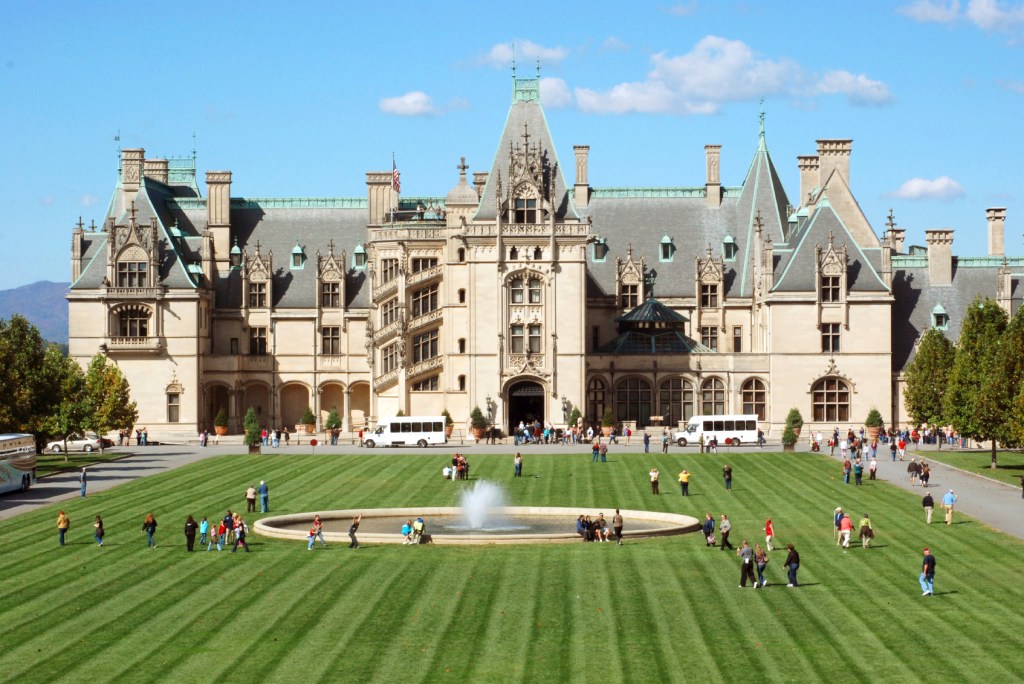
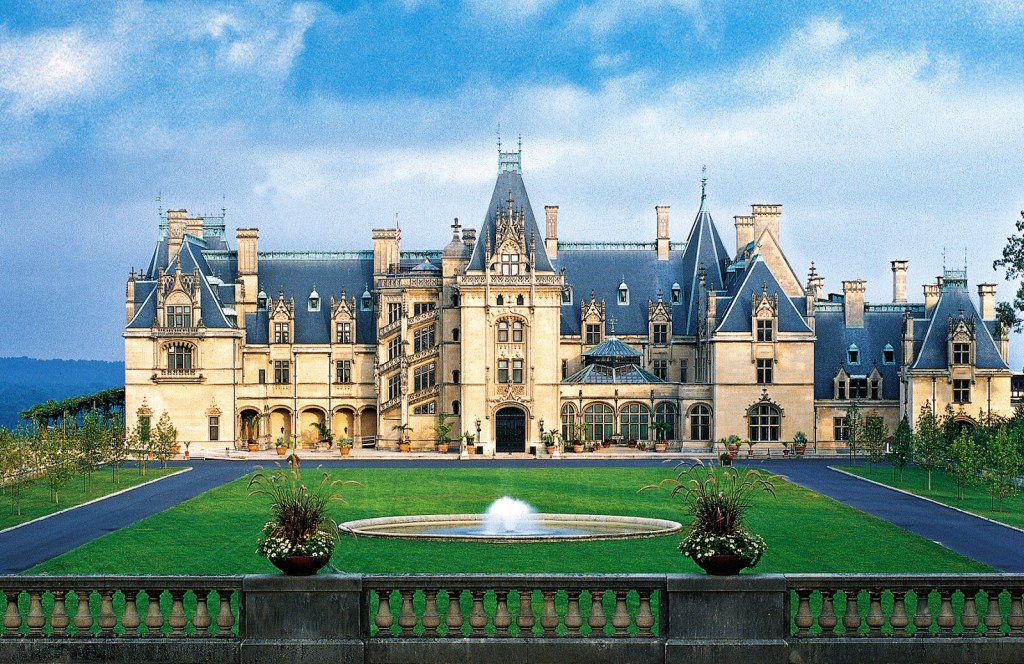
The story of Biltmore is well documented but here is a brief recap. It was the creation of George Washington Vanderbilt, a grandchild of Cornelius Vanderbilt, the 19th century railroad and steamship baron who started off with a single sailboat in Staten Island, New York and ended up with the largest fortune in the U.S. at the time, about $200 billion in today’s money. Illiterate, crass and profane, Vanderbilt was nevertheless a financial genius. He left most of his fortune to his eldest son, William Henry Vanderbilt, who doubled the value of his inheritance during his life. William Henry and his wife Maria had eight children and when William passed away in 1885 these kids took their inheritances and cut loose on houses, yachts and parties becoming the poster children of gilded age excess that is portrayed in movies, books and television. The youngest of these eight kids was George. His elder brothers ran the railroads while young George indulged in books and art. George also suffered from respiratory difficulties and in the 1880s at the suggestion of his doctors George started visiting Asheville for the warm, dry air and then started buying up small farms south of town. Much of this land had been overworked and was in poor condition and George had a vision of creating a modern version of a European feudal estate where the locals would live in villages that he created and work on farms and artisanal workshops on the estate while their children were educated in schools he built. The house was modeled after the chateaux that George had seen along the Loire valley in France and was designed by Richard Morris Hunt. The grounds were designed by Frederick Law Olmsted, generally regarded as the pioneer of landscape architecture in the U.S. At 179,000 square feet, Biltmore is the largest house ever built in North America.

By 1895 the house was completed and three years later George married Edith Stuyvesant Dresser, a descendant of the Dutch colonial governor of New Netherland (which eventually became New York). People have often commented on the lack of feminine touches in the design and decor of Biltmore and that is because it was built by a bachelor. Edith didn’t arrive on the scene until it was already built. George and Edith had three other homes in NYC and Maine. If you’re ever in Manhattan visit the Versace store on Fifth Avenue and you’ll be standing in George and Edith’s former townhome. Unfortunately, George’s vision of a self-supporting manorial estate didn’t pan out and after he died in 1914 at age 51 after a botched appendectomy his widow was forced to start selling parts of the estate to pay for taxes and maintenance. Part of the former estate is now a portion of the Pisgah National Forest and other parcels eventually became absorbed by the expanding city. The house started welcoming visitors as early as 1930 to help pay the bills.
George and Edith had one child, Cornelia Stuyvesant Vanderbilt. Cornelia grew up at Biltmore and after coming into her inheritance she married John Francis Amherst Cecil, a descendant of William Cecil, chief advisor to Queen Elizabeth I. Cornelia and John lived at Biltmore for a few years but Cornelia grew bored and restless and moved to Paris in 1934, dyed her hair pink, changed her name to Nilcha and divorced John. She never returned to the U.S. and married two more times before passing away in 1976. John and Cornelia had two sons, William A.V. Cecil and George H.V. Cecil, and after Cornelia bolted for Paris John stayed on at Biltmore and raised the boys until they left for school in England and Switzerland. John never remarried, managed the estate and lived in the bachelor wing of Biltmore until his death in 1954. Between 1956 and 1976 Biltmore, still owned by the absent Cornelia, stood empty but welcomed paying visitors.
When Cornelia died in 1976 William and George Cecil inherited the estate which included the house and a dairy business, a remnant of the artisanal industries that George Vanderbilt had started 80 years before. By this time Biltmore was an enormous white elephant that bled money. George, as the elder brother, got to pick what he wanted to inherit and he picked the dairy which at least turned a modest profit. William got stuck with the money-losing house. William essentially had a choice. Try to make Biltmore pay for itself, see if the federal or state government would take it on as a national park or house museum (as happened with Hyde Park his great uncle’s home in New York), try and sell it or demolish it.

As with Biltmore and the Cecil brothers, owners of huge historic houses in Western Europe also faced severe financial difficulties in the postwar era. The ravages of war, taxes to pay for the war, houses requisitioned for military use and then beat up and postwar societal attitudes that frowned upon architectural excess left owners with mostly bad choices. Some owners sold off their ancestral houses and lands that in many cases had been in the family for centuries or donated their houses to non-profits like the National Trust in England or to the local community in France. In England, hundreds of historic homes were demolished in the postwar era although most of the truly unique and attractive houses survived. Even though many historic homes had welcomed visitors for centuries the postwar era saw the emergence of the stately home industry where owners began to aggressively promote their properties as tourist attractions. Aristocratic landowners accustomed to the privacy that a large estate afforded became aggressive marketers and entrepreneurs opening up restaurants, gift shops, wedding chapels and the like. Today when you visit a historic home like Blenheim Palace or Chatsworth in England you will be rubbing shoulders with hundreds of visitors, wedding guests or business people hosting an event. Even with all this extra income the business of running a big historic house is typically little better than a break-even endeavor. But at least it keeps the house in the family and owners get to enjoy it during the off hours.

The Cecil brothers followed this model at Biltmore. George sold the dairy business and opened a winery and tasting room and parceled out much of the Biltmore agricultural land for residential and commercial development, hotels and shopping centers. Other parts of the estate have been developed for a wide range of tourism related uses. There is a mountain biking center, an equestrian center, a fitness center, a spa, several restaurants, a wedding venue, meeting facilities, banquet facilities, two hotels, a wide variety of retail shops, a nursery center, a shooting range, hiking trails, even a falconry center. And lest we forget there is also the Biltmore mansion that is open for tours starting at $70 per person and running as high as $130 per person at Christmas time when the house is decorated for the holidays. There are attractions for children as well but Biltmore has really become what some jokesters have dubbed “Disneyland for Adults.” Biltmore has become a major economic engine of Asheville and the major tourist attraction of western North Carolina. In the stately house industry Biltmore has become a model for not just financial sustainability but also a lucrative business for the Vanderbilt-Cecils, something that the original builder could never have imagined and wasn’t able to achieve. The chart below shows annual attendance figures for Biltmore and some of its peers in the stately and historic house industry. As shown, Biltmore is near the top of the table.
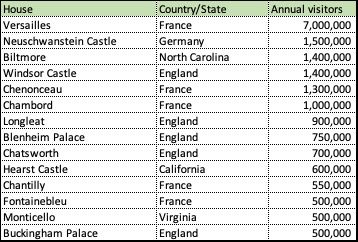
Note: if you include all castles then sleeping beauty’s castle at Disneyland has them all beat with 17 million annual visitors.

Of the fourteen houses in the table above, five are still used as homes today at least part of the year. Biltmore isn’t one of them. It hasn’t been lived in for nearly 70 years. Both of the Cecil brothers passed away by 2020 and the two businesses, Biltmore Company (which runs the house and most of the tourist attractions) and Biltmore Farms (the winery and property development arm), are now run by their children who live in smaller, more modern and manageable homes. While purists might decry the commercialism of Biltmore or similar properties in Western Europe it must be remembered that few of these houses were ever able to pay for themselves even at their peak in the 17th and 18th centuries. Their finances were pressured by factors beyond their owners control such as declining agricultural prices, wars, depressions, confiscation by communist regimes, death and taxes. Tourism has saved most historic houses especially the truly big ones like Biltmore or Blenheim Palace in England. Income from tourism pays for the upkeep and most of these houses have never looked better. Biltmore is just the extreme example of this trend and arguably the most successful.
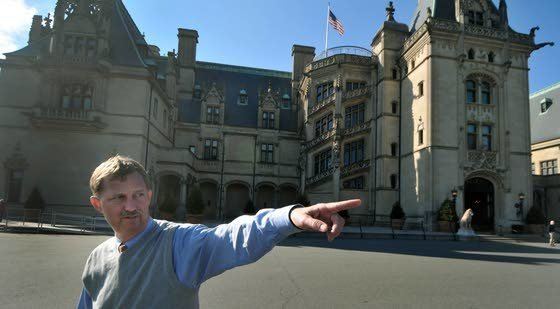
Bill Cecil, great grandson of the builder of Biltmore and current owner

For more on Vanderbilt houses be sure to click here for a post about Hyde Park, the creation of George Vanderbilt’s brother, Frederick, in New York as well as information on the mansion building binge of that generation of Vanderbilts. Or click here for a post about the stunning High Lawn house, uniquely the only gilded age Vanderbilt house that is still lived in by the family. For information about visiting Biltmore, click here. Double check your available credit card balance and have fun.

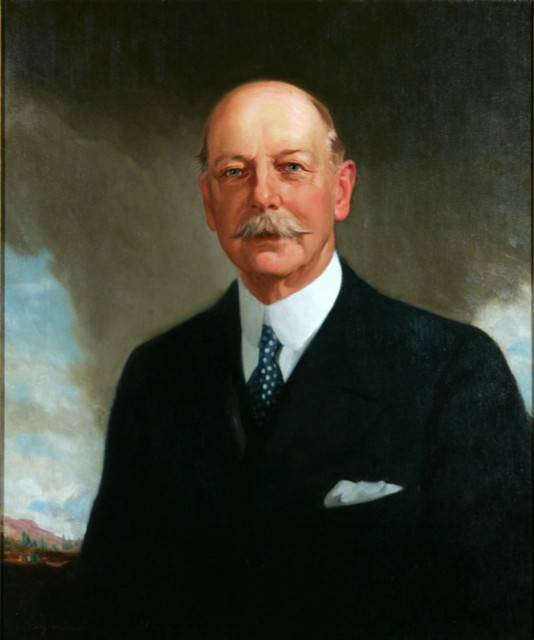
Hyde Park

Hyde Park was the country estate of Frederick William Vanderbilt (1856-1938). Frederick was the grandson of “the Commodore”, Cornelius Vanderbilt, the steamship and railroad tycoon who was the richest person in the United States during the middle part of the 19th Century. Despite having little education, Cornelius built up a fortune of $105 million ($150-200 billion in today’s money depending on who’s counting). Cornelius had an insatiable love of money but spent very little on himself (or his long-suffering wives) and had a remarkable mind for numbers. He kept very few accounting records and managed his vast enterprise mostly in his own head. When Cornelius passed away in 1877 he left nearly everything to his eldest son, William Henry Vanderbilt. Cornelius had 13 children and considered all of them to be idiots but thought that William Henry might have some glimmer of hope. Despite this lack of confidence in his potential, William Henry proved to be a competent financier and railroad executive and doubled his inheritance before passing away in 1885. However, he was the last Vanderbilt to add to his inheritance rather than just spending it (Anderson Cooper may be the one exception). Although he enjoyed his fortune more than the Commodore did, William Henry’s Fifth Avenue house in New York was only a small sign of what was to come from the Vanderbilts.

Frederick William Vanderbilt, the proprietor of Hyde Park

William Henry and his wife, Maria Louisa Kissam Vanderbilt, had nine children, eight living to adulthood. These eight children took their inheritances and cut loose, unleashing a deluge of home building that eclipsed anything that the royal houses of Europe had accomplished in such a short period of time. The houses either bought or built (nearly all built) by this generation of Vanderbilts is listed below:

That’s 32 mansions for 8 people (plus dependents) or four mansions per Vanderbilt. This is even more remarkable considering the size of these houses. Of the 25 largest homes ever built in the United States, six are on this list including the largest of them all, Biltmore, weighing in at 179,000 square feet. Biltmore is also the only one of these houses that is still owned by a Vanderbilt (though it is not used as a residence). Click here for more on Biltmore. Shelburne Farms is now a non-profit educational center, hotel and working farm focused on sustainability with Vanderbilt descendants still involved in the management.

Coffered ceiling in the dining room of Hyde Park

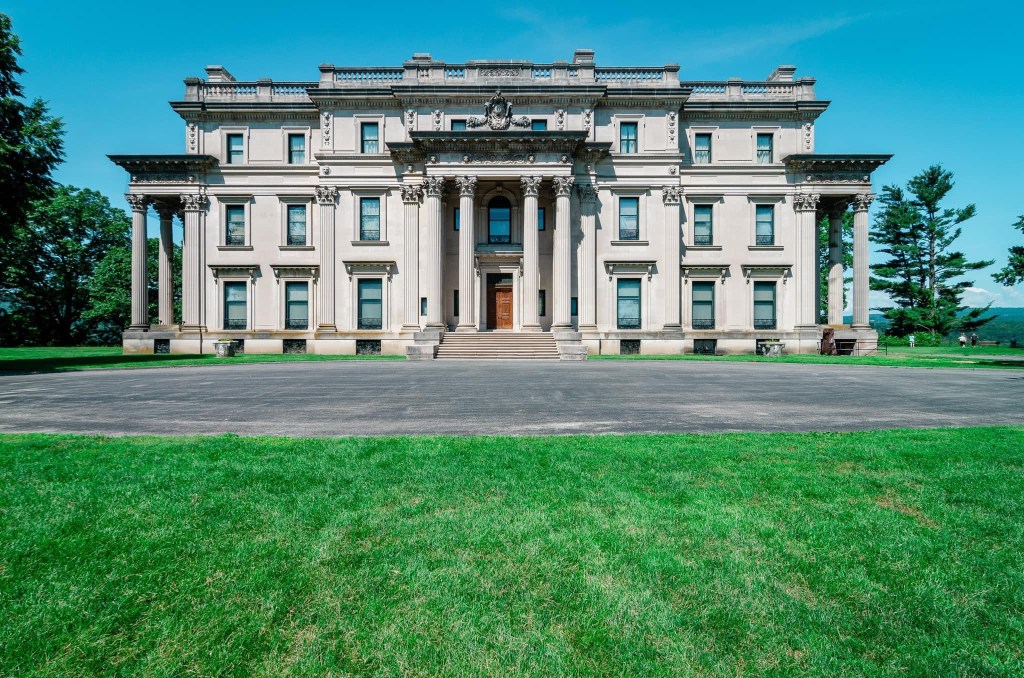
Emily Thorn Vanderbilt also built one additional notable house not on this list, High Lawn, for her daughter, Lila Vanderbilt Sloan. High Lawn is the only Gilded Age Vanderbilt mansion that is still lived in by a Vanderbilt and is covered in this blog (click here). Most of the houses on this list are either long gone, have been overrun by suburban development or, in the case of the Newport “cottages”, are really more of a luxury subdivision, not true country houses. But Hyde Park is unique in that it still retains the form of a country estate although it hasn’t been lived in for 83 years.

Hyde Park has been used as a country estate and retreat since the early 18th century when it was granted to Pierre Fauconnier in 1705 by the colonial Governor of New York, Edward Hyde, the Viscount Cornbury. In fact, the mansion we know as Hyde Park is the third house to stand on the site which is on a bluff overlooking the Hudson River and the Catskill Mountains to the west. In 1840 the estate was purchased by John Jacob Astor the Manhattan fur and real estate tycoon for his daughter, Dorothea. She and her husband, Walter Langdon, built the second house but soon afterwards Walter died and Dorothea moved to Europe. Her son, Walter Jr., took over in 1852 and expanded the estate to 600 acres. A few miles north of Hyde Park is Marienruh, another Astor house built in the 1920s.

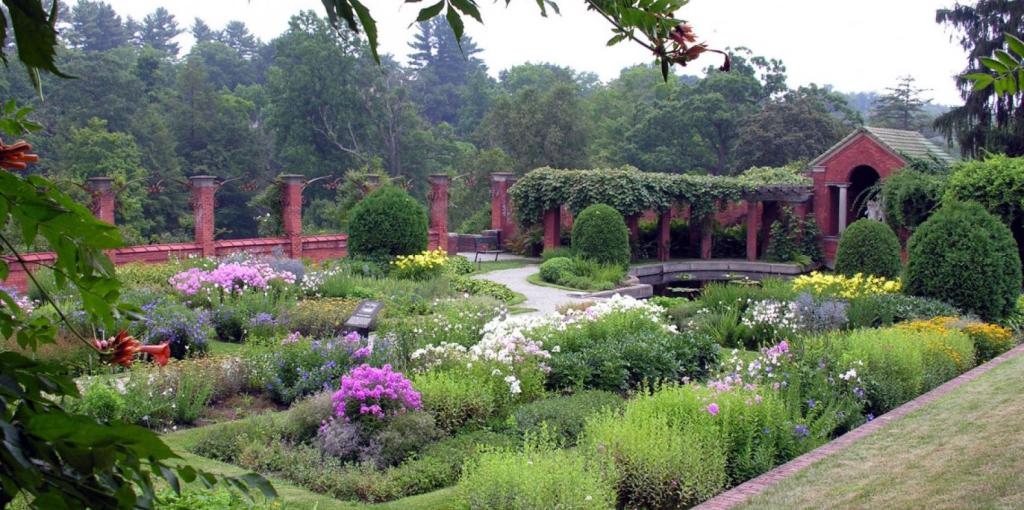
Walter Jr. died without heirs in 1894 and the estate was bought by Frederick William Vanderbilt and his wife Louise . Their initial inclination was to simply make additions to the Langdon house but their architect, Charles McKim of McKim, Mead and White, discovered severe dry rot in the structure and advised a complete rebuild. McKim designed the 50,000 square foot Neo-classical structure and construction was completed by 1899. The estate was attractive to the Vanderbilts for a couple of reasons. First, the railway that ran just below the house along the Hudson River happened to be the New York Central, which was the flagship of the Vanderbilt industrial empire. Frederick was a Director of the NY Central for 61 years although he did not pull rank when traveling between Hyde Park and New York City, preferring to sit in a regular coach rather than a private railway car as most gilded age millionaires would have done. Reserved and scholarly by nature, Frederick was the only one of his siblings to graduate from college, earning a degree from Yale University in Horticulture. He indulged his interest in horticulture at Hyde Park and devoted considerable attention to improving the landscaping that prior owners had installed at the estate. Frederick was responsible for developing the italianate formal gardens that still flourish today (thanks to the efforts of local volunteer-gardeners). The house itself was not universally admired. Some critics thought it more resembled a public library than a stately home and criticized its heavy and ponderous design elements. This didn’t seem to bother the Vanderbilts though. Of their many properties they seemed to prefer Hyde Park above the others.

On the grounds of Hyde Park

Louise Vanderbilt died in 1926 and this seemed to make the reserved Frederick even more shy. He lived as a virtual recluse at Hyde Park for the rest of his life, only seeing family and close friends, rarely speaking to the Hyde Park staff and spending his time puttering in the grounds and gardens. Frederick and Louise did not have children and when Frederick passed away in 1938 the house was left to Louise’s niece, Margaret “Daisy” Post. Daisy already had her hands full managing mansions in Newport and the south of France and wanted nothing to do with the cost and hassle of running Hyde Park as well but couldn’t find a buyer in the depths of the Depression so she approached the owner of a nearby estate, President Franklin D. Roosevelt, for advice. FDR grew up and still resided part of the year at his ancestral estate of Springwood a couple miles south of Hyde Park and he had been an occasional guest of the Vanderbilts at Hyde Park. It was FDR who suggested donating the estate to the National Park Service and opening it up to the public. Daisy agreed and by 1940, Hyde Park was open to the public (except when FDR was staying at Springwood when his aides and secret service detail would temporarily take up residence at Hyde Park).

Formal gardens at Hyde Park

If you want to visit Hyde Park, it can be reached by car or train (transferring to a bus in Poughkeepsie) from either Albany or New York City. Additional information can be found here. Leave time in your schedule for visiting nearby Springwood, the home of FDR. In addition to the final resting place of FDR and Eleanor Roosevelt, Springwood has educational and quite moving exhibits about the life and times of FDR and the challenges the the country faced during the Great Depression and the Second World War. Info regarding Springwood can be found here. Finally, almost directly across the Hudson River from Hyde Park is another notable country estate, Omega, covered in this blog (click here).

High Lawn

The Vanderbilt family is famous for incalculable wealth, gilded age mansions, blue jeans and Anderson Cooper. Many fans of gilded age mansions know about those that were built by members of the Vanderbilt clan such as the Biltmore Estate in North Carolina, The Breakers in Newport, RI or Hyde Park in New York (click here for more on Hyde Park). Most people assume that the Vanderbilt mansions have long since been converted into museums and that the Vanderbilt descendants now live like the rest of us mere mortals. Although some Vanderbilt descendants have done well in business, the arts or academia or are minor members of the English aristocracy others lead decidedly middle class lives.

The Vanderbilt fortune that was built up in the 19th century through astute investments in steamships and railroads has been so diluted through inheritance and multiple divorces or squandered on fine living throughout the decades that most contemporary Vanderbilts are merely comfortable, not filthy rich. By way of example, one of the bigger chunks of contemporary Vanderbilt money is in the hands of someone with no Vanderbilt blood at all (and potentially has never even met a Vanderbilt). A certain John Hendrickson had been working as a government official in Alaska and living in a two-bedroom condo in Anchorage when he met and married former actress and horse breeder Marylou Whitney. Marylou, in turn, had previously been the fourth and final wife of Cornelius Vanderbilt Whitney and inherited $100 million when C.V. died in 1992. When Marylou (who was 40 years older than John) died in 2019, the former Alaska government employee inherited her fortune.

Due to these sorts of twists and turns, contemporary Vanderbilts mostly live in nice, but unremarkable homes. But there are a few exceptions. One truly notable exception is the home of James Spencer-Churchill, the 12th Duke of Marlborough and great grandson of the famously reluctant bride, Consuelo Vanderbilt. The Duke owns (and sometimes even lives in) England’s Blenheim Palace, which is almost twice as large, and also twice as nice, as the Biltmore Estate. For more on Biltmore, click here. On this side of the Atlantic sits a more down-to-earth exception known as High Lawn, nestled in the Berkshire Mountains near Lee, Massachusetts.

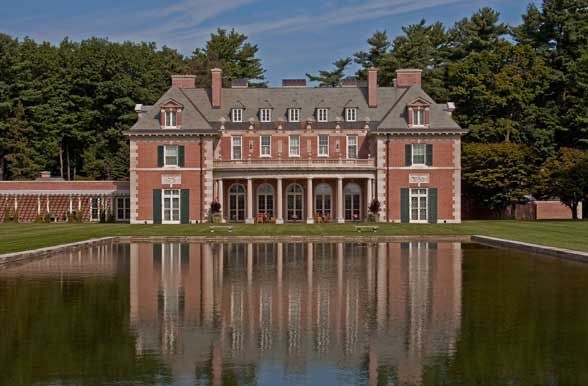
High Lawn was designed by the New York architectural firm of Delano and Aldrich and completed in 1910. It is 25,000 square feet and sits on a 1,600 acre estate. The house was a wedding present for Lila Vanderbilt Sloan, a great grand daughter of Cornelius Vanderbilt. The bas-relief sculptures above the French doors in each bay of the facade were created by Lila’s cousin, Gertrude Vanderbilt Whitney. Along with the pleasing proportions, red brick, dormers and the limestone quoins, High Lawn is a striking example of Georgian revival house design. I only have one quibble: would it have killed the architect or the builder to match the chimneys visible from the front?

Cornelius Vanderbilt was known as “The Commodore” and at one time was the richest person in the United States. Cornelius started off with a single sail boat ferrying passengers between Staten Island and Manhattan, built a fleet of steamships and eventually ended up with a railroad empire with the New York Central Railroad as the centerpiece. Known to his contemporaries as crude, brutal and vulgar and barely literate, Cornelius nevertheless was a brilliant business innovator and built up a fortune that would be worth $200 billion in today’s dollars, on par with Jeff Bezos or Bill Gates. BTW, in fairness to old Corny, most of his competitors back in the day were also crude, brutal and vulgar.

Lila and her husband, William Osgood Field, used High Lawn as a vacation home and upon Lila’s death in 1934, the estate was purchased by her daughter, Marjorie Field. Marjorie and her husband, H. George Wilde, developed a dairy farm business on the property, High Lawn Farm, that has become internationally renown for breeding high quality jersey cows. The farm is still in operation to this day and can be visited by the public although High Lawn House is still a private home and not open to the public nor is the house visible from the dairy or any public road. If you do visit the dairy, stop by the store and try their purple cow milk shake.

Marjorie passed away in 1997 and the estate and farm came under the control of her son, George William “Bill” Wilde, a great great great grandchild of The Commodore. Bill, who passed away in 2013, was a graduate of Princeton and the Harvard Business School, served in the U.S. Marine Corps and was an investor in addition to being in the dairy business. Presumably, High Lawn is now controlled by his widow and heirs.

High Lawn lives on as one of the few (and probably the only) “Vanderbilt mansion” that is still lived in by a Vanderbilt, going on 115 years of continuous family ownership (140 years if you count just ownership of the land).

Just one mile north of High Lawn is another beautiful country house, The Mount, which is covered in this blog (click here for more).

Blenheim Palace in England, a “Vanderbilt Mansion” that predates the Vanderbilts by 150 years and at 301,000 square feet is almost twice as large as Biltmore. The owner is the 12th Duke of Marlborough and the great great great great grandson of the Commodore, Cornelius Vanderbilt. Hold my beer, Biltmore.
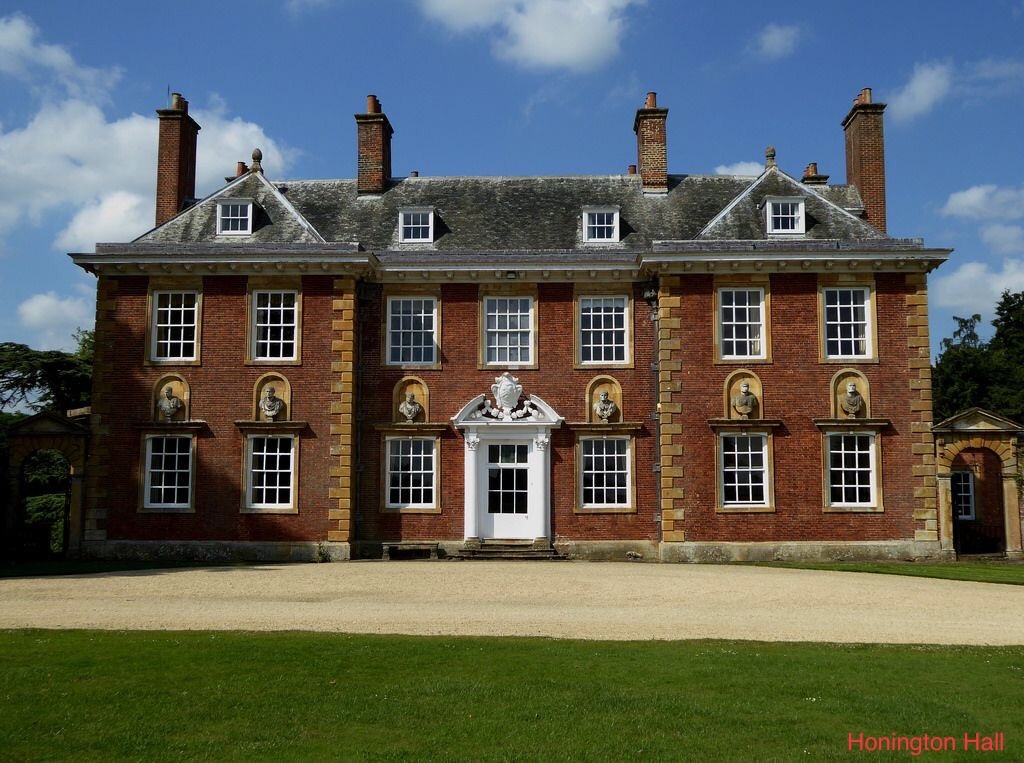
English perfection in Honington Hall in Warwickshire built in the 17th century. Could this house be the inspiration for High Lawn?