Tulip Hill

George Washington slept here. He really did. Washington was a good friend of the builder of Tulip Hill, Samuel Galloway, and visited often during the 1770s. Tulip Hill is a Georgian-style house (actually built during the Georgian era) near Galesville, Maryland. The 8,000 square foot house sits on an 93 acre waterfront property on the West River.

Tulip Hill got started when Samuel Galloway bought the 260 acre Poplar Knowle property in 1755. He renamed it Tulip Hill for the tulip poplars that grew on the property. Samuel built the gorgeous Georgian-style house for his wife, Ann, but she died before the house was completed in 1762. Unfortunately, the identity of the architect is unknown. Samuel Galloway grew and exported tobacco at Tulip Hill and also traded in slaves imported from Africa and other indentured servants. He was also a major ship owner and owned more than 30 ships and a nearby shipyard. Samuel passed away in 1785 leaving Tulip Hill to his son, John. John Galloway expanded the house by adding the matching wings and connecting hyphens creating the classic five-part Georgian house that exists today.

Samuel Galloway, the builder of Tulip Hill

Tulip Hill stayed in the Galloway family until 1896. It was then sold to Alexis du Pont Parker, a railroad executive from Denver, CO. During the Parker ownership, the house was all but abandoned and became known to local teenagers as a place to party. In 1918, house was purchased by Henry Flather, a Washington D.C. banker and his wife, May, who was very active in building up the Girl Scouts during the early years of the organization. The Flathers are credited with extensively restoring the house and grounds after decades of neglect. Tulip Hill was then purchased in late 1948 by Lewis Andrews, a British military officer who had been a POW during the Second World War, and his wife, Hope. After Lewis’ death in 1990, the estate was bought by Morgan Wayson, a local contractor, and his wife, Janet. The Waysons put Tulip Hill on the market in 2004 for $4.9 million and it was eventually sold by auction in 2011 for $2.5 million. The trail of ownership grows cold after that and there is local speculation about the identity of the owner and what they plan to do with Tulip Hill but it is private property and not open to the public.

Entrance front
Entrance hall

Bonnie Doone

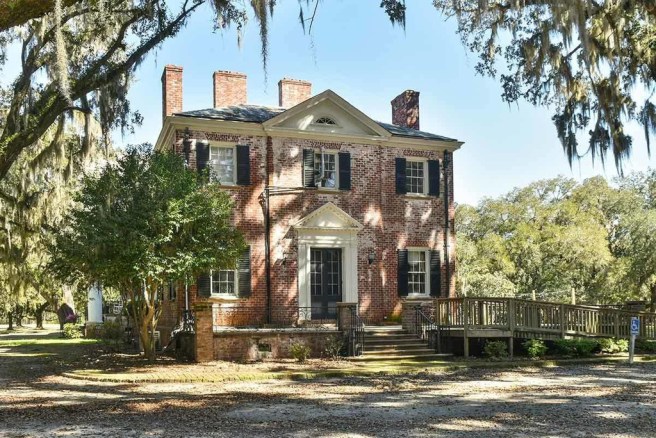
This handsome Georgian revival house is known as Bonnie Doone and is located near Waterboro, South Carolina. The house is 9,700 square feet and is surrounded by gardens on a 131 acre estate. Originally, Bonnie Doone was part of a 1722 land grant from King George I and changed hands several times before it was bought by Dr. Theodore DeHon who built a plantation house. However, when the Union Army passed through South Carolina towards the end of the Civil War they had different ideas for the plantation and burned it down. As the Union forces were wrapping up the remains of the confederate army in 1865, they were particularly destructive in South Carolina since that State was the first to secede from the union in 1860. Between 1865 and 1911, the plantation (sans a plantation house) was mostly used for rice cultivation and passed through various owners.

In 1931, the plantation was purchased by a New York City stockbroker named Alfred Caspary. Mr. Caspary also bought some adjoining properties and formed an estate of 15,000 acres. One of these adjoining properties was known as Bonnie Doone and Mr. Caspary applied that name to the whole lot. He also commissioned the construction of the Georgian revival house that sits there today. This house was completed in 1932 on the same site as the former plantation house that was destroyed in the Civil War.

Besides being a successful stockbroker, Mr. Caspary was most famous as a philatelist or stamp collector. He amassed one of the greatest stamp collections of the 20th century and reportedly spent $50,000 per year on acquisitions. His purchases were so discerning that his nickname in the stamp collecting world was the “Connoisseur.”

When Mr. Caspary passed away in 1955, two years after his wife, Margaret, the estate sat for a few years before being purchased in 1965 by the Charleston Presbytery, a unit of the Presbyterian church, and was converted into a retreat center. In 1978, the estate was subdivided and 132 acres plus the house was bought by the Charleston Baptist Association and they also used the property as a retreat center for their church community. Much of the rest of the estate was sold to timber companies. In 2019, Bonnie Doone was bought for $2.5 million by Gene Slivka, a Georgia businessman, who has purchased a few other former plantations in the southern states. Presumably, Bonnie Doone is again being used as a private home. A video showing Bonnie Doone can be seen on Youtube here.