Mountain Meadow

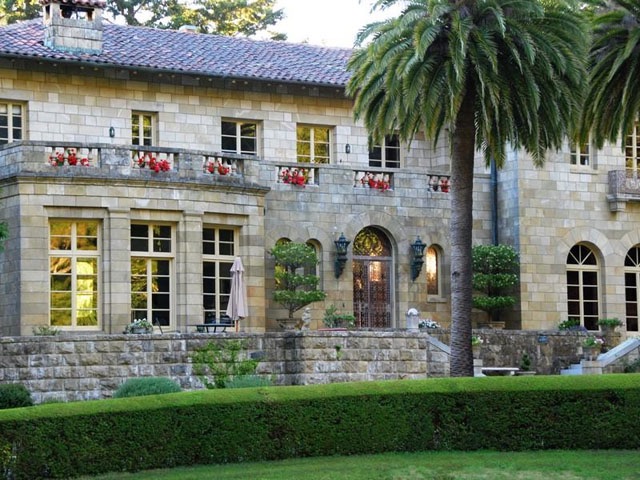
Big rural estates with classically designed houses are rare in the western U.S. Most wealthy people in the west congregate closer together on the weekends in places like Santa Barbara or Napa Valley when not residing closer to the big cities. The few exceptions were built in the early decades of the 20th century. In the San Francisco Bay Area it was once fashionable to carve out large estates in San Mateo County. Most of these were long ago carved up for suburban development but a couple of relics remain. Villa Lauriston is one such example, still in private hands. Filoli, near Woodside, is another example that is now open to the public, is a popular wedding venue, and includes a notable garden. Mountain Meadow (AKA the Phleger Estate) is another relic that still exists in private hands (for now at least).

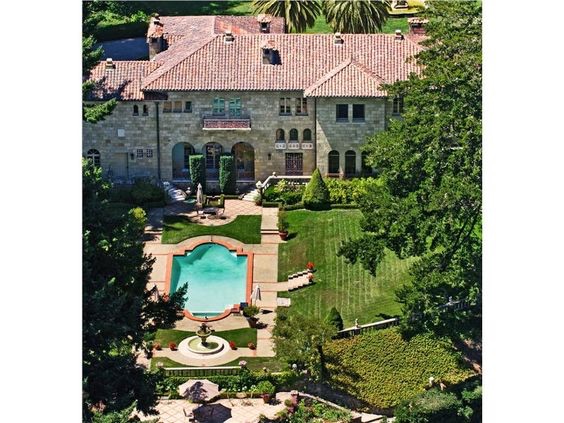
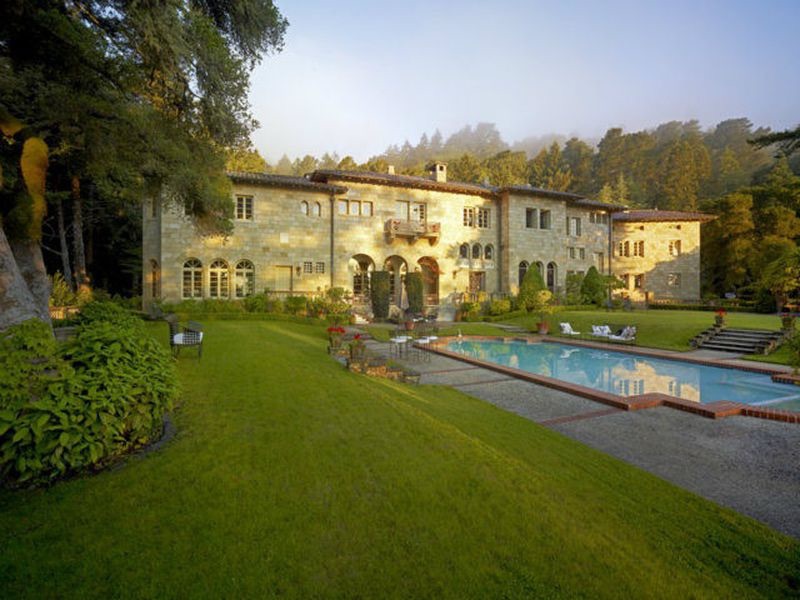
Mountain Meadow was once part of the Spring Valley Water Company, a water utility and reservoir for San Francisco owned by William Bourn. Bourn built his weekend house, Filoli, on company land and in 1927 he carved out a section and sold it to Samuel Eastman, a Vice President with Spring Valley, and his wife Adelaide. Eastman hired the architect, Gardner Dailey, to design the 8,000 square foot house that sits on the estate today, a fusion of mission and tudor styles that the Eastmans called Summerholm.

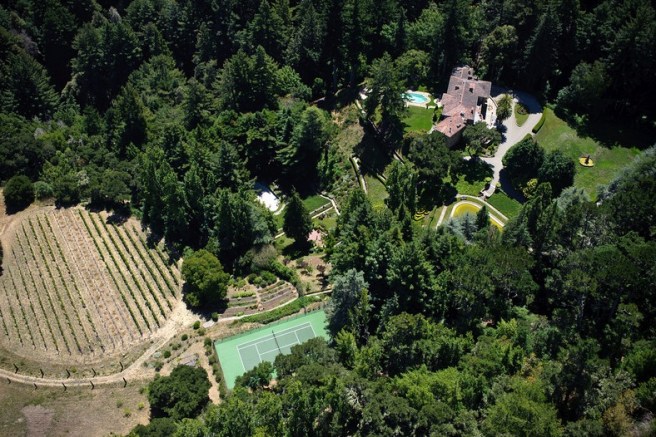
In 1935 the Eastmans sold Summerholm to Herman and Mary Elena Phleger. The Phlegers bought adjoining parcels to create a 1,300 acre estate that they dubbed Mountain Meadow. Herman Phleger was a Harvard-trained lawyer from Sacramento who became a major force in California, national and international legal circles. He frequently represented big corporations trying to bust labor unions and was a personal attorney to William Randolph Hearst, the archetype of sensationalist journalism and misinformation and the builder of Hearst Castle. Herman was even one of Hearst’s pallbearers at his funeral. On the positive side of the ledger, Phleger served as legal counsel to the prosecutors at the Nuremberg trials of nazi war criminals and was instrumental in restructuring the German government and economy in the wake of the Second World War. He was heavily involved in arms control, reducing Cold War tensions with the Soviet Union and negotiating many of the treaties that define the post-war era. Herman Phleger died in 1984 and soon afterwards his widow and daughter began the process of selling most of Mountain Meadow to the Peninsula Open Space Trust. This process was completed in 1994 and most of the estate was transferred to the Golden Gate National Recreation Area as a park and natural area open to the public.

The house itself and 24 acres were carved out of the sale to the Trust and separately sold in 1991 to Gordon and Betty Moore. Gordon Moore was a co-founder and CEO of Intel, the maker of most of the microprocessors that power today’s personal computers and laptops. The Phleger family has also held on to 23 acres of the former Mountain Meadow estate. The Moores used their home, still called Mountain Meadow, as a weekend retreat until 2023 when both Gordon and Betty passed away a few months apart. Mountain Meadow is currently for sale for $29.5 million. The listing can be seen here.

Bloedel Reserve

Reflecting pond and the entrance front of the house

This is the Bloedel Reserve, a 150 acre country estate and botanical garden on Bainbridge Island, Washington State. Separated from Seattle by Puget Sound and only accessible by the State ferry, Bainbridge Island has been able to retain its woodsy, bucolic vibe despite being within visual range of downtown Seattle. Historically, it was a favorite place for the city’s elite to build weekend houses or retirement pads. The Bloedel Reserve was originally a country retreat known as Collinswood for Angela Collins, the widow of Seattle’s fourth mayor. Ms. Collins built the 10,000 square foot Scandinavian-style manor house, designed by J. Lister Holmes, in 1931.  In 1951, the estate was purchased by Prentice and Virginia Bloedel, both members of prominent northwest timber families. Prentice was an executive for many years with his family’s wood products company, MacMillan Bloedel Limited (since merged with Weyerhaeuser). When the Bloedels bought the estate, the surrounding land had been repeatedly logged and was in poor condition. The Bloedels dedicated the better part of their remaining lives to rehabilitating the land and creating a botanical garden that blended a woodland garden with elements of Japanese garden design. The San Francisco landscape architect, Thomas Church, had a major role in the overall design but Prentice himself was also a big creative influence. Thomas Church’s other commissions included designs for Stanford University and UC Berkeley. To realize the vision, the Bloedels doubled the acreage, created ponds, a reflecting pool, a Japanese garden and tea house, a waterfall, a moss garden and a rhododendron glen. The Bloedels called the property Agate Point Farm after a nearby geographic feature.

One of the reflecting ponds on the grounds

In 1970, the Bloedels gifted the property to the University of Washington but continued to live at Agate Point Farm until 1984 when they moved to their house in Seattle. In 1974, the property was renamed The Bloedel Reserve. In 1986, ownership was transferred to the Arbor Fund and two years later the property was opened to the public. Virginia Bloedel passed away in 1989 and Prentice Bloedel in 1996. Their former country estate is now regarded as one of the most innovative and beautiful woodland gardens in the world.  

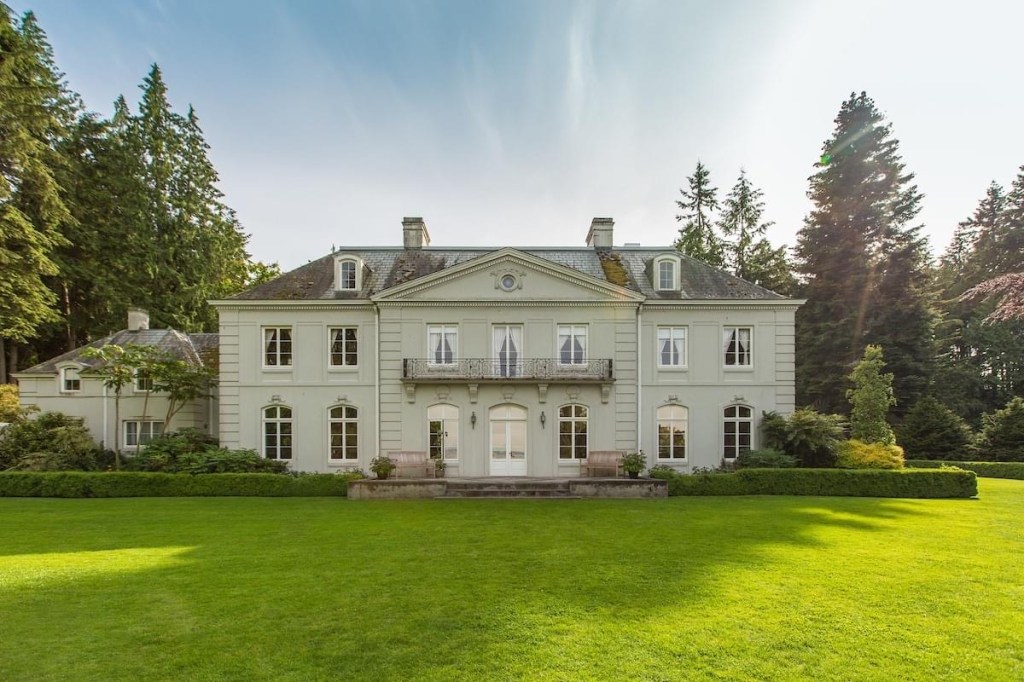
Entrance front

The Bloedels were also significant art collectors and patrons of the Seattle Art Museum. In 1997, it was discovered that a Matisse that had hung at the estate and at the Museum had been stolen by the Nazi regime in France in 1940.  After a period of negotiation, the painting was restored to the heirs of the original owner in 1999. The Bloedel’s daughter, Virginia Wright, was also a major patron of the arts in Seattle. Her husband, Bagley Wright, was famous for being the developer of the Space Needle, Seattle’s answer to the Eiffel Tower.

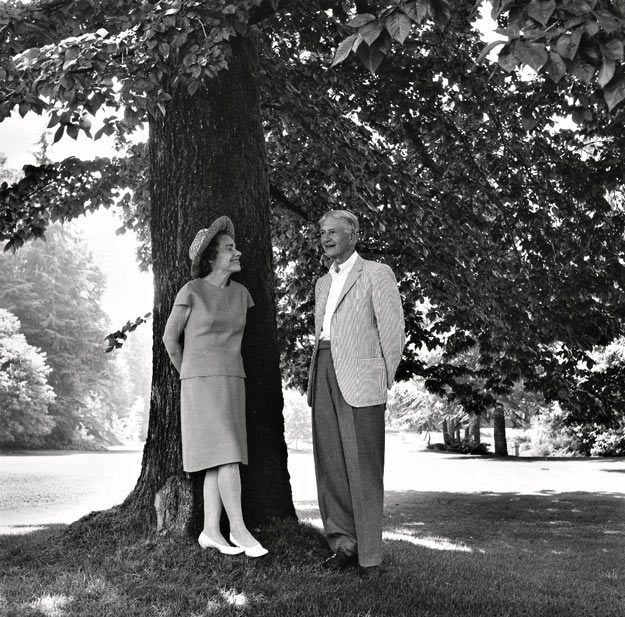
Virginia and Prentice Bloedel, second owners of the estate and the creators of the gardens

The Bloedel Reserve is now open to the public and the residence is a house museum that is little changed from when the Bloedels lived there. Click here for more information on the Reserve or here for a short YouTube video showing the property.

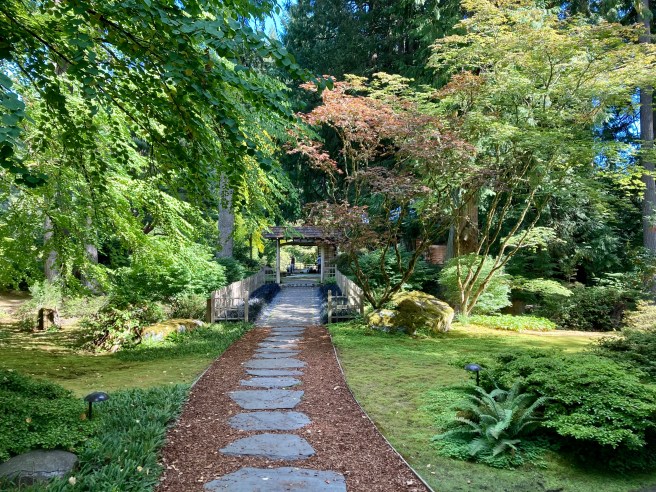
Entrance to the Japanese Garden

Reflecting pool. The final resting place of both Prentice and Virginia Bloedel is at the far end of the pool.

Northeast facade of the house overlooking Puget Sound

Northeast facade of the house

Villa Lauriston

In the early decades of the 20th century, the business and financial elites of San Francisco built country estates south of the city in San Mateo County in a similar manner that wealthy New Yorkers built on the Gold Coast of Long Island or Philadelphians migrated to the Main Line. Upscale peninsula towns such as Hillsborough are a modern day evolution of this development trend. Most of these estates have since been subsumed into the suburban development that occurred after World War II or have been torn down to make way for development. A few of these estates still retain an element of their bucolic past such as Filoli in Woodside or the nearby Phleger Estate (click here for more on Phleger). A little further south stands another relic of this time period, Villa Lauriston in Portola Valley.

Villa Lauriston was the creation of Herbert Law, an Englishman by birth who migrated to San Francisco by way of Chicago. Herbert and his brother, Hartland, were wheeler dealers of the first order and traded in San Francisco real estate including buying the Fairmont Hotel a few days before it was damaged in the 1906 San Francisco earthquake. But their biggest innovation was starting the Viavi Company which peddled homeopathic medicines which were supposed to enhance the health and libido of women. Using the proceeds from his medication and real estate businesses, Herbert engaged architect George Schastey to design his estate. The result, completed in 1926, was the 16,000 square foot, Florentine-style Villa Lauriston which sat on a 1,000 acre estate in Portola Valley. During prohibition, Villa Lauriston was used as an illegal stash for all the liquor and wine that had been removed from Mr. Law’s San Francisco hotel properties. Herbert lived at the Villa with his wife, Leah, and their daughter, Patricia, for 11 years.

The story of Patricia is a sad one. Raised by nannies, educated at home by tutors and then at Stanford University, her parents started building a separate grand villa on the estate just for her when she was only five years old. In a macabre twist of the Cinderella legend, the manor-born, Stanford-educated Patricia fell in love with a gas station attendant, also named Stanford, in 1942 and much to the consternation of her parents married him while she was still in school. He then shipped off to the Pacific to fight the Japanese as a U.S. Marine. Perhaps as a result of parental pressure, Patricia divorced Stanford as soon as he returned from the war. One month later, Patricia was discovered, asphyxiated, in her car with a garden hose running from the exhaust into the car’s interior. Next to her was a couple of books. Apparently, she decided to do some reading while she drifted off into eternal sleep. Patricia’s unfinished villa slowly fell into ruin and burned in 1971.

The Laws sold Villa Lauriston to John Neylan in 1937. Mr. Neylan was the personal attorney for William Randolph Hearst (of Hearst Castle fame), was on the Board of Regents for the University of California for 27 years and was a member of the Bohemian Club, one of those secretive, ultra-exclusive organizations dogged by conspiracy theories that they secretly run the world. While associated with the UC, Mr. Neylan promoted the career and vision of the nuclear physicist, Ernest Lawrence, who founded Lawrence Livermore National Laboratory. Legend also has it that Mr. Neylan burned all of W.R. Hearst’s personal papers at Villa Lauriston upon the publisher’s death in 1951 – much to the consternation of Mr. Hearst’s enemies, creditors and biographers. Mr. Neylan lived at Villa Lauriston for many years before passing away in 1960. His heirs apparently struggled with Villa Lauriston before selling the estate to a group of investors in 1969. These investors dedicated most of the estate’s woodlands to conservation and subdivided the rest to carve out a couple of other residential properties leaving Villa Lauriston with about 29 acres.

After 1970, Villa Lauriston changed hands a couple of times. A sleazy commodities dealer held it for a while. Then a Silicon Valley tech entrepreneur named Norio Sugano bought it for $3.7 million. This latter day history of the Villa is an object lesson in the sheer cost and difficulty of maintaining such extravagant homes. Mr. Sugano had similar luck as the previous owners and the home was forced into foreclosure in 2012 although he did add a vineyard for growing wine grapes. It was sold at auction in 2013 for $13 million after being listed for as much as $20 million. The current owner is reportedly Eric Schmidt, the former CEO of Google.

The story of Villa Lauriston points out the difficulty of owning such large estates. On the other (more civilized) side of the Santa Cruz Mountains, much smaller, more manageable estates in Woodside sell for $20 million plus and find takers. There is a subset of wealthy individuals and families willing to take on the management of a large country estate but it can become a full-time job and the subset isn’t a big fraction of the home owning public. Fortunately for the nation’s architectural heritage, people like Mr. Neylan, Mr. Sugano and Mr. Schmidt step up and preserve these priceless (or just hard to price) homes. For those interested in more info on Villa Lauriston, an entertaining video is available on Youtube here or you can click here for a Youtube video with some more history on the house and those lived in it.

Oh….if you want to buy some of Mr. Law’s medicines, you still can. Viavi Company still exists at http://www.theviavicompany.com