This is Belmere, a 300 acre estate near Georgeville on Lake Memphremagog which straddles both Quebec and Vermont. Belmere has been under construction for the last few years as a private Xanadu by the secretive former CEO of the Montreal-based Power Corporation of Canada, Robert Gratton.
If you’re a Quebecois who has either made it big in business or otherwise stumbled into a pile of money then you’ll likely want to build a home on Lake Memphremagog where the elite of Montreal spends their weekends and holidays. Belmere is the most spectacular property on the lake (or any lake) with its own private peninsula and acres of formal gardens. In fact, the formal gardens at Belmere may be the most extensive in North America.
Belmere was originally the 19th century summer home of Sir Hugh Allan, a successful Scottish-Canadian shipping magnate. In the early 1990s it was sold by Sir Allan’s heirs and came under the control of Mr. Gratton. Mr. Gratton has been building his palatial estate for the past 15 years and is still not completed. The maintenance areas of the estate are so extensive in their own right that a traffic light is needed to control the traffic. Belmere is private property and not open to the public.
Another country house associated with the Power Corporation of Canada is Domaine Sagard, the remote, palladian palace built by Mr. Gratton’s former boss, Paul Desmarais. Domaine Sagard is covered in this blog here.
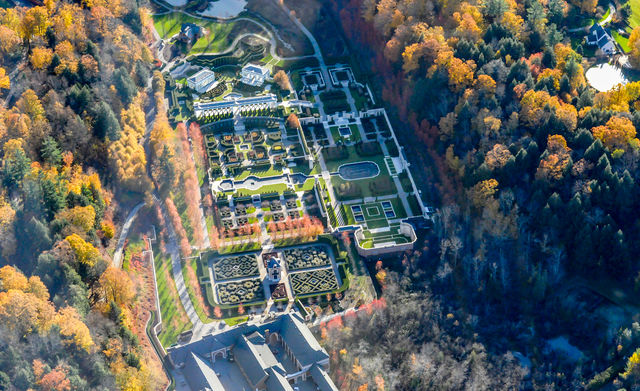
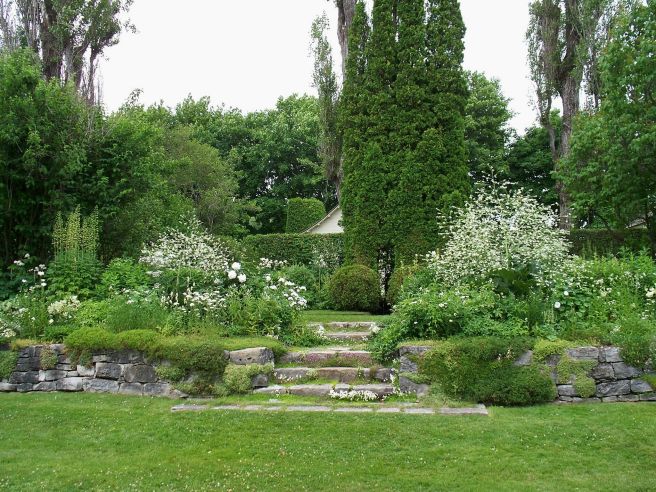
Les Quatre Vents (pronounced lay KAT-ruh vah)(translation: the four winds) is almost unknown outside gardening circles. But among gardeners and horticulturists it has a mythical reputation. Les Quatre Vents is a 200 acre estate a few miles northeast of La Malbaie, Quebec overlooking the St. Lawrence River. The property that became Les Quatre Vents was purchased in 1902 as a vacation retreat for a branch of the Cabot family. The Cabots were one of the leading families of Boston, the so-called Boston Brahmins. They and the other Boston Brahmins established themselves in New England in the 18th century and grew wealthy from trading and shipping. Typical trading runs for New England-based traders in the 17th and 18th century included West Indian sugar and rum to colonial America, American tobacco to Europe, African slaves to the West Indies, and Chinese tea, silk and porcelain to Europe. It also included one particularly lucrative trade: Turkish opium to China, sort of the early American version of the Sinaloa Cartel. The Cabots moved on from shipping, slaving and drug running to politics producing U.S. senators and ambassadors. The Cabots were big political rivals of the Kennedys in the mid 20th century and competed for Massachusetts senatorial seats in Congress.
The chateauesque manor house on the property was designed by New York architect Frederick Rhinelander King to replace an earlier 1928 house that burned down in 1956. The current house was completed in 1959. An interesting side note regarding Mr. King is that he competed in the 1936 Berlin Olympics back when architecture and other art forms were actual medal events. In 1965, Francis “Frank” Higginson Cabot inherited Les Quatre Vents and undertook the gradual creation of the incredible landscape garden that exists today. Frank was Harvard-educated and worked on Wall Street for many years before deciding that his true gift was landscape architecture and horticulture. Frank and his wife, Anne, had already created an outstanding garden at their weekend retreat outside of New York City, called Stonecrop Garden, that is now open to the public. In 1975, they moved to Les Quatre Vents full-time and devoted their retirement to developing the gardens. Frank was a true plant hunter and travelled around the world looking for specimens to try out at Les Quatre Vents.
One of Frank and Anne’s major achievements was the creation of The Garden Conservancy in 1989. The Conservancy is a non-profit organization dedicated to preserving notable gardens, both private and public, for the enjoyment of future generations. They do this through grants and advocacy and, to date, have been instrumental in preserving more than 100 gardens in 26 states and provinces, gardens that might have otherwise fallen victim to development once their gardener-creators had passed away.
Frank Cabot passed away in 2011 but Les Quatre Vents is still in the family and they continue to pursue Frank’s vision. Les Quatre Vents is not open to the public although they do conduct tours four or five days each summer. Tour tickets are reportedly very difficult to get and require advance planning. For anyone interested in getting a close look at Les Quatre Vents, an excellent documentary about the Cabots and their garden, called The Gardener, was produced in 2018 and can be seen on YouTube here. In addition, Frank Cabot wrote a book about Les Quatre Vents loaded with beautiful photos of the gardens called The Greater Perfection (out of print but available on Amazon for several hundred dollars).
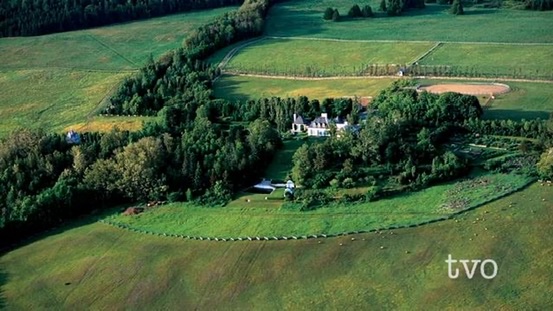
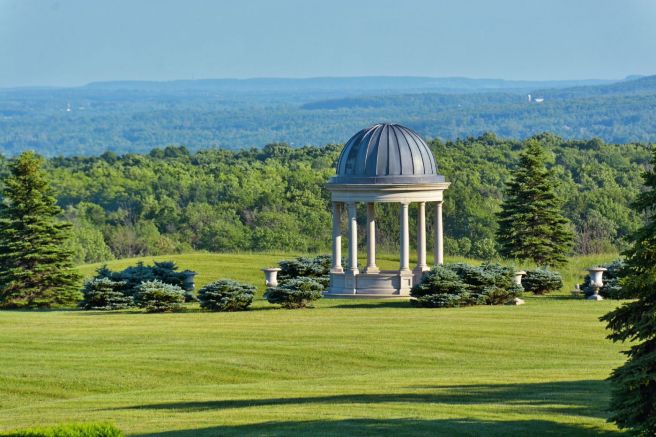
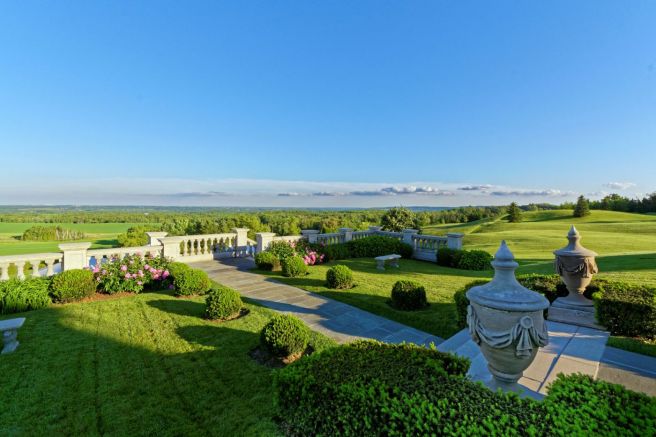
Do you like mowing the lawn? Then you might be ecstatic at the thought of owning Escarpment House! Designed by Joe Brennan of Toronto, completed in 2005 and boasting 14,000 square feet on 165 acres overlooking the distant Toronto skyline, Escarpment House is an attractive neo-georgian house in Caledon, Ontario. Originally it was known as Stoneridge Hall and the original owners put it on the market for $17 million in 2015, found no takers and eventually slid down the pricing scale to $10 million when it was sold to a Toronto-based property management and investment/golf resort operator called Longbridge Partners.
Longbridge partners also bought two golf courses that are located on either side of Escarpment House and have since been trying to market the house as a “stay and play” property for golf vacationers or as use for meetings and conferences. A Youtube video produced when the estate was on the market can be found here. If you want to stay at Escarpment House then click here for more info.
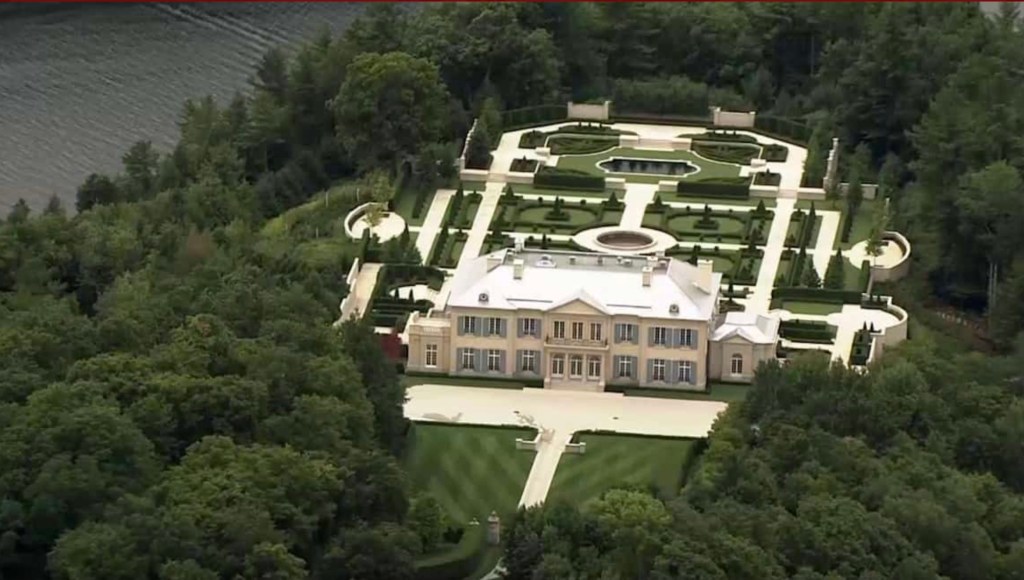
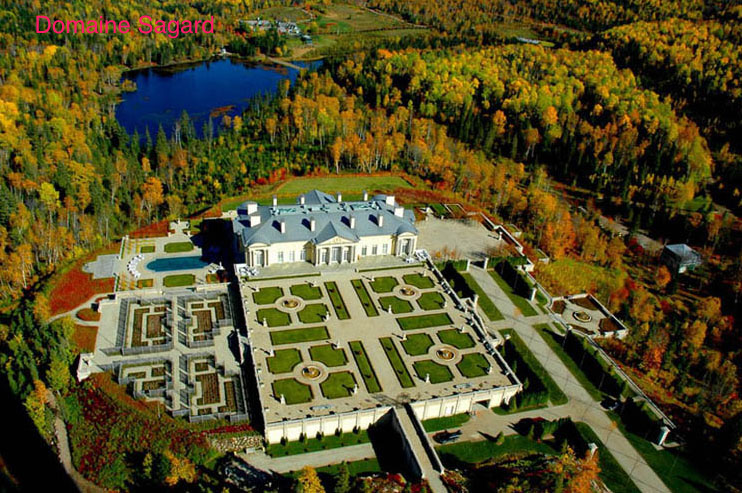
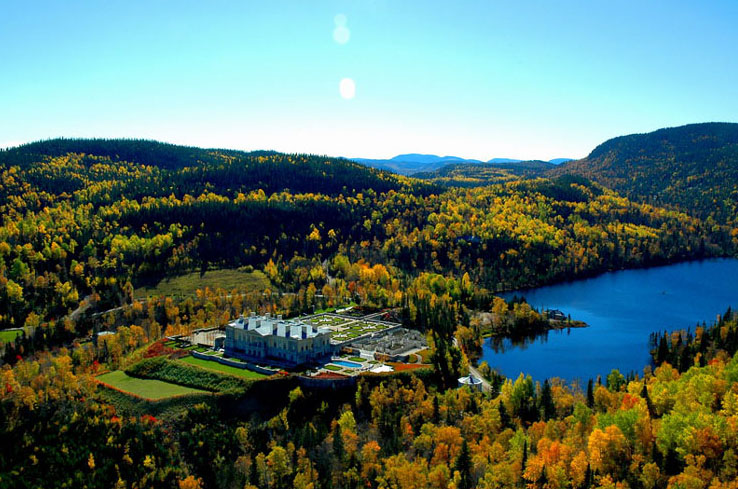
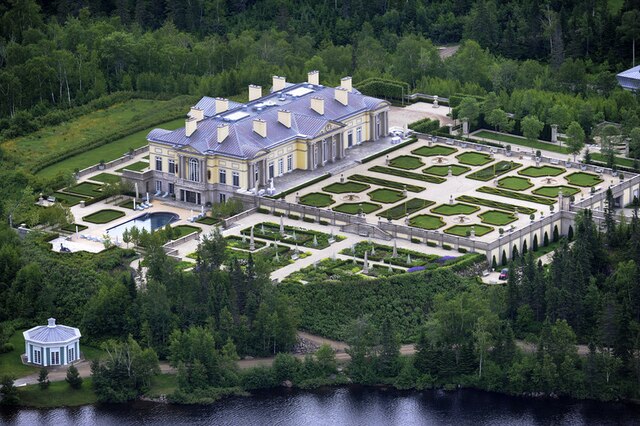
This 70,000 square foot house is called Cherlieu and sits on a vast private estate in the Laurentian mountains of Quebec called Domaine Sagard. Domaine Sagard is approximately 100 miles north of Quebec City and covers 21,000 acres. The palladian palace of Cherlieu was completed in 1997 to a design by Quebec City architect, Sylvain Larouche. Domaine Sagard is the creation of Paul Desmarais, the founder of the Montreal-based Power Corporation of Canada.
Mr. Desmarais was born in the bleak nickel mining town of Sudbury, Ontario in 1927. He started his business career in 1951 by taking over the family’s money-losing local bus company for a dollar, expanded to other busing companies and utilities in Ontario, and eventually built up the Power Corporation of Canada into a $50 billion conglomerate with interests in financial services, transportation, media and wood products. Some say that Mr. Desmarais’ business acumen was helped along by considerable political acumen as well. Several Canadian Prime Ministers have been on the payroll of Power Corporation either before or after their terms in office or have served on various Power Corporation boards. Mr. Desmarais was also friends with former French President Nicolas Sarkozy and former U.S. Presidents George H.W. Bush, Bill Clinton and George W. Bush. Many of these politicians have made the trek to the remote estate for parties and receptions. Mr. Desmarais passed away in 2013 followed by his wife of 60 years, Jacqueline Maranger, in 2018 and presumably the estate is now controlled by the Desmarais’ four children. Assuming you could even find Domaine Sagard, it is not open to the public.
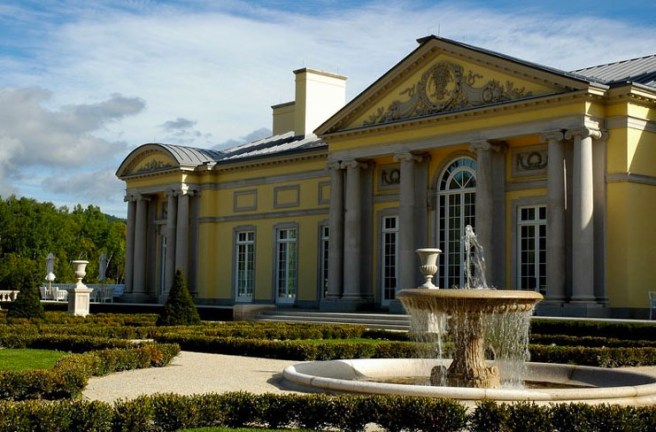
Mr. Desmarais was obviously a very clever guy but I’m not sure how I feel about his house. On the one hand its palladian symmetry, porticoes and columns and baroque flourishes are really unique in North America, something you’re more likely to see in St. Petersburg or Vienna. On the other hand I don’t think the design complements the setting well. Such a refined design, not to mention the yellow finish and formal gardens, would blend in better in a more civilized setting, not a forested and mountainous environment. Here it sticks out like a sore thumb. A Scottish baronial castle design using rougher textures, a more dramatic roof line and a landscape garden would have been a better choice for this setting. Nevertheless you have to admire the effort that went into planting a palace in the middle of the Quebec wilderness.
Click here for a satirical YouTube video that shows scenes from Domaine Sagard and also shows the ambivalence that the Quebecois have about their plutocrats. Another country house associated with the Power Corporation of Canada is Belmere, a creation of the company’s former CEO, Robert Gratton (click here for more on Belmere).
Paul Desmarais, builder of Domaine Sagard, on the left. Canadian Prime Minister Brian Mulroney on the right. Presidents George I and George II in the middle.











 North American Country Estates