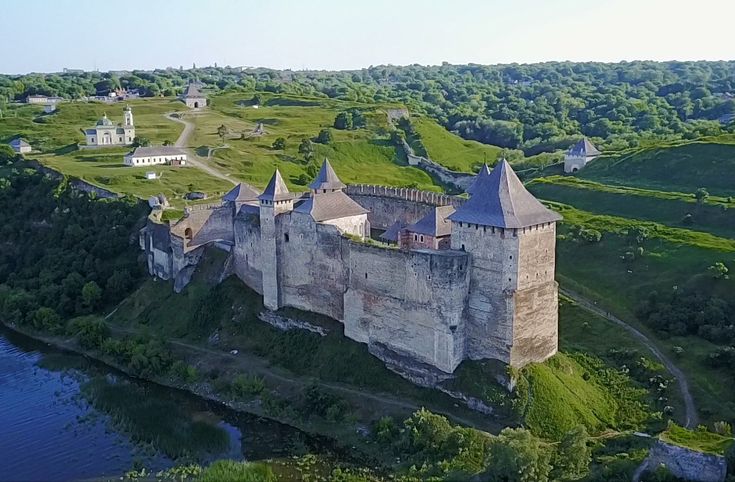
This is Khotyn Castle (or fortress) near the town of Khotyn, Ukraine. There has been a fort or castle here since the 10th century and, like the surrounding region, it has been tossed around between empires and conquerors every few decades. What eventually became Ukraine is a large land area that has been variously part of the Wallachian Kingdom (present day Romania), the Ottoman Empire (now Turkey), Kievan Rus (based in present-day Kyiv), the Polish-Lithuanian Commonwealth, the Kingdom of Poland, the Austro-Hungarian Empire, the Russian Empire and the USSR finally gaining independence in 1991 upon the dissolution of the USSR. Despite what Vladimir the Conqueror claims, the present-day country of Ukraine, as a whole, has never really had a consistent historical connection with any current day nation. Western Ukraine has been part of the Polish-Lithuanian Commonwealth (later the Kingdom of Poland) most consistently. Eastern Ukraine has been influenced mostly by the Russian Empire. The City of Kyiv sort of sits in the middle.
Khotyn Castle sat at the crossroads of several trade routes between the Black Sea, Russia, Poland (in its various permutations), the Balkan states and Scandinavia. For this reason, Khotyn Castle has been fought over multiple times. In a notorious siege in 1673, the future King of Poland, Jan Sobieski, led an army against the Ottomans to capture Khotyn and put it firmly in the hands of the Poles. General Sobieski’s description of the battle at the castle will sound familiar to anyone who is following the news from present day Ukraine:
More than 60 guns were thundering non-stop, the sky was in flames and smothered in smoke, the earth was quaking, the walls were groaning, the rocks were splitting into pieces. That which my eyes captured throughout the day was indescribable. It is impossible to convey the persistence and courage, or rather despair, with which both parties were fighting”
General Jan Sobieski looks back at the artist right before charging in to take Khotyn Castle from the Turks
Like Ukraine and its capital Kyiv for the moment, Khotyn Castle withstood the siege (and others that came afterwards). Today, the castle is a museum (one of the “7 wondrous castles of Ukraine”) and more information can be found here.
This is Rose Hill, an 11,000 square foot Georgian-revival house on a 410 acre estate in Greenwood, Virginia a few miles west of Charlottesville. The house was designed by William Bottomley who is credited with many Georgian masterpieces in the Old Dominion especially in the Richmond area (for other Bottomley homes in this blog click here for Half Way House or here for Chilton). The house was completed in 1930 for Susanne Williams Massie, the widow of a Richmond banker. In the early decades of the 20th century, some of Richmond’s elite established summer homes in the Greenwood area and Rose Hill is surrounded by several of these homes, most of which still exist. The area continues to be a rural enclave of historic estates, horses and gardens. One of these estates, Tiverton, which is just west of Rose Hill, is covered in this blog (click here).
Susanne passed away in 1952 and the home was purchased a few years later by Henry Bradley Martin. Mr. Martin was the grandson of Henry Phipps, a partner of Andrew Carnegie in the Carnegie Steel Corporation (later U.S. Steel). The Phipps family built several homes in the leafy suburb of Old Westbury, N.Y. on Long Island including what is arguably one of the most attractive homes in North America, Westbury House, now known as Old Westbury Gardens. The Phipps family took their steel money and put it into an investment firm called Bessemer Trust which pioneered the concept of a “family office”, a privately owned investment firm that serves the needs of a single wealthy family by investing, disbursing funds, minimizing tax liabilities, arranging private planes, getting the merc serviced, etc.
Westbury House AKA Old Westbury Gardens, a Phipps family home located in the town of Old Westbury on Long Island, NY
Henry was educated at Oxford University and served in North Africa during the Second World War as part the Office of Strategic Services (O.S.S.) the forerunner of the C.I.A. Henry was also a noted book collector who used Rose Hill to house his extensive collection which included the only privately owned copy of the original Declaration of Independence and an extensive collection of books on ornithology (i.e., the study of birds). Henry passed away in 1988 and left Rose Hill to his daughter, Alice Martin Takach. Alice and her husband, Stephen, use Rose Hill as a summer home. Rose Hill is a private home and is not open to the public.
Reflecting pond and the entrance front of the house
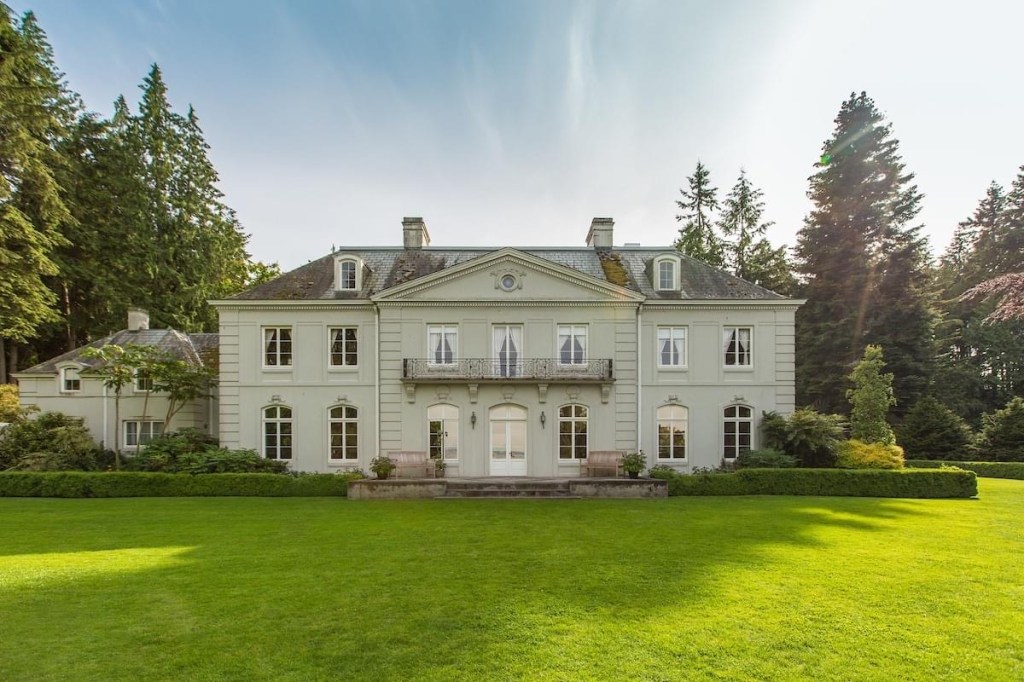
This is the Bloedel Reserve, a 150 acre country estate and botanical garden on Bainbridge Island, Washington State. Separated from Seattle by Puget Sound and only accessible by the State ferry, Bainbridge Island has been able to retain its woodsy, bucolic vibe despite being within visual range of downtown Seattle. Historically, it was a favorite place for the city’s elite to build weekend houses or retirement pads. The Bloedel Reserve was originally a country retreat known as Collinswood for Angela Collins, the widow of Seattle’s fourth mayor. Ms. Collins built the 10,000 square foot Scandinavian-style manor house, designed by J. Lister Holmes, in 1931. In 1951, the estate was purchased by Prentice and Virginia Bloedel, both members of prominent northwest timber families. Prentice was an executive for many years with his family’s wood products company, MacMillan Bloedel Limited (since merged with Weyerhaeuser). When the Bloedels bought the estate, the surrounding land had been repeatedly logged and was in poor condition. The Bloedels dedicated the better part of their remaining lives to rehabilitating the land and creating a botanical garden that blended a woodland garden with elements of Japanese garden design. The San Francisco landscape architect, Thomas Church, had a major role in the overall design but Prentice himself was also a big creative influence. Thomas Church’s other commissions included designs for Stanford University and UC Berkeley. To realize the vision, the Bloedels doubled the acreage, created ponds, a reflecting pool, a Japanese garden and tea house, a waterfall, a moss garden and a rhododendron glen. The Bloedels called the property Agate Point Farm after a nearby geographic feature.
One of the reflecting ponds on the grounds
In 1970, the Bloedels gifted the property to the University of Washington but continued to live at Agate Point Farm until 1984 when they moved to their house in Seattle. In 1974, the property was renamed The Bloedel Reserve. In 1986, ownership was transferred to the Arbor Fund and two years later the property was opened to the public. Virginia Bloedel passed away in 1989 and Prentice Bloedel in 1996. Their former country estate is now regarded as one of the most innovative and beautiful woodland gardens in the world.
Entrance front
The Bloedels were also significant art collectors and patrons of the Seattle Art Museum. In 1997, it was discovered that a Matisse that had hung at the estate and at the Museum had been stolen by the Nazi regime in France in 1940. After a period of negotiation, the painting was restored to the heirs of the original owner in 1999. The Bloedel’s daughter, Virginia Wright, was also a major patron of the arts in Seattle. Her husband, Bagley Wright, was famous for being the developer of the Space Needle, Seattle’s answer to the Eiffel Tower.
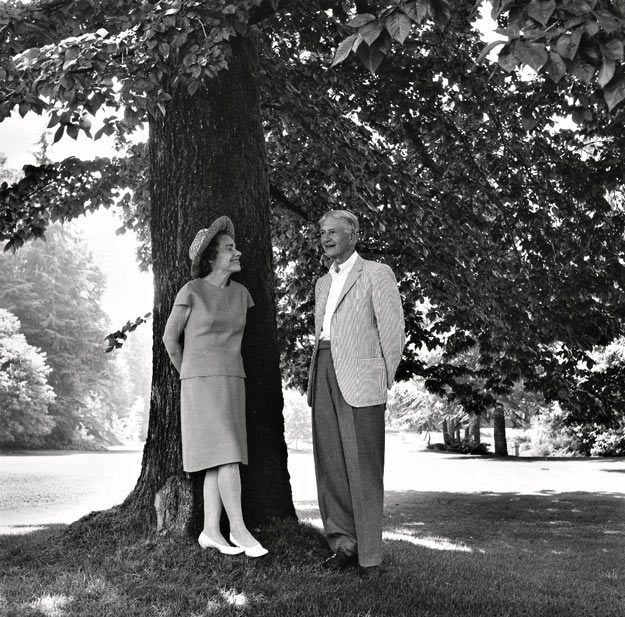
Virginia and Prentice Bloedel, second owners of the estate and the creators of the gardens
The Bloedel Reserve is now open to the public and the residence is a house museum that is little changed from when the Bloedels lived there. Click here for more information on the Reserve or here for a short YouTube video showing the property.
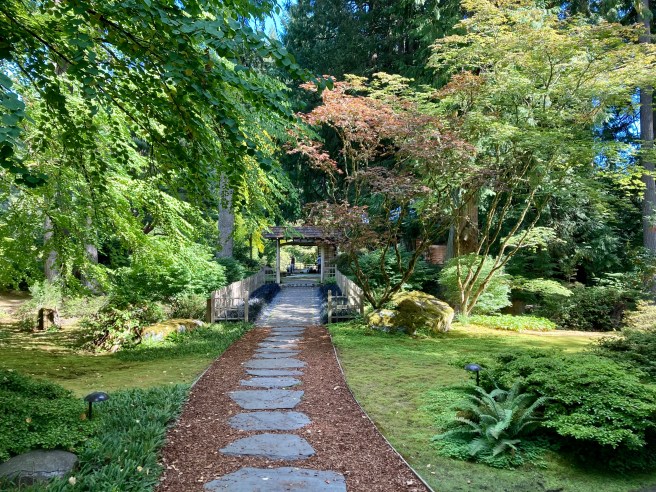
Entrance to the Japanese Garden
Reflecting pool. The final resting place of both Prentice and Virginia Bloedel is at the far end of the pool.
Northeast facade of the house overlooking Puget Sound
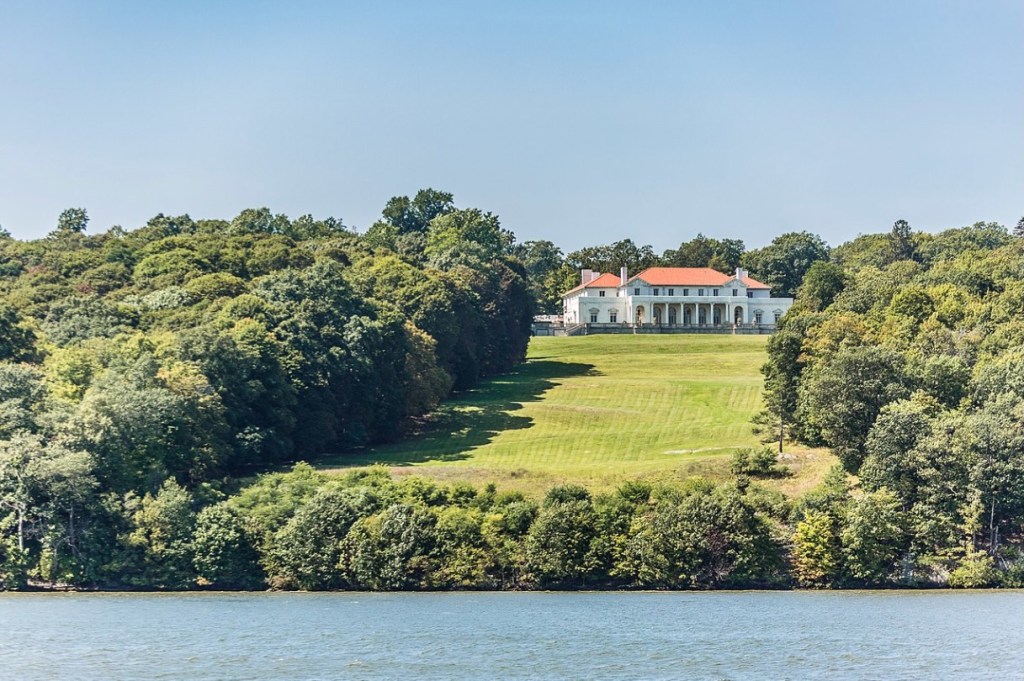
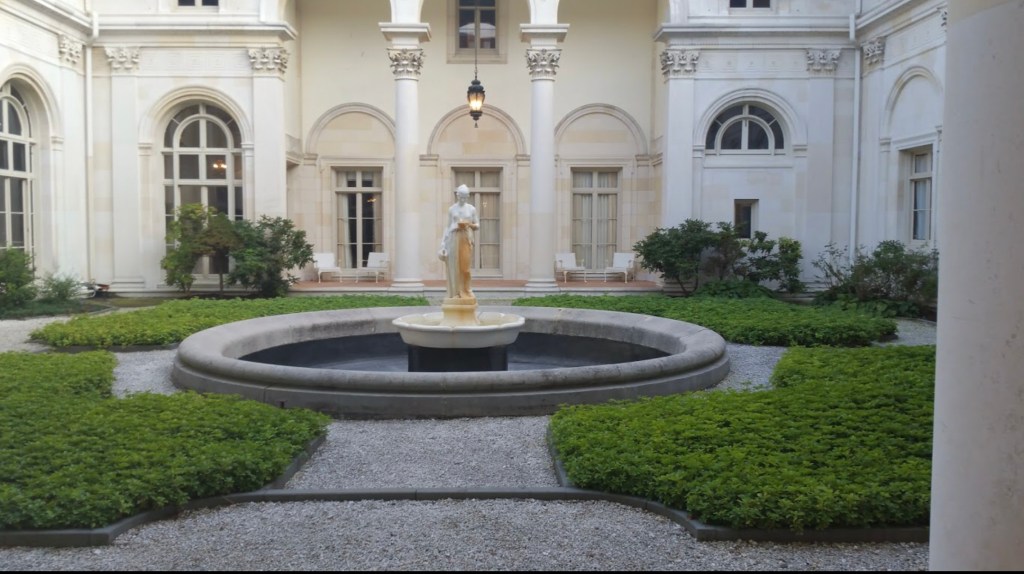
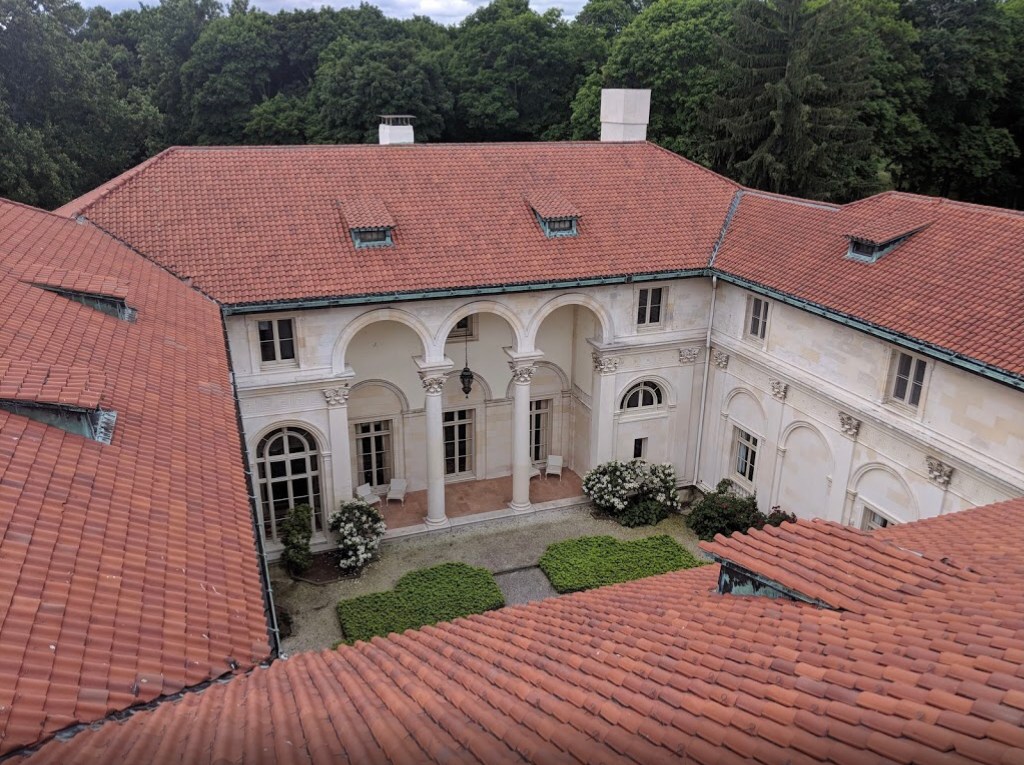
This is the Omega estate (AKA the Payne Estate) on the west bank of the Hudson River near Esopus, New York. The Beaux Arts style house was designed by Thomas Hastings of the New York architecture firm, Carrere & Hastings. The 42,000 square foot house was completed in 1911 and is sited on a 60 acre estate. The estate that eventually became Omega had three previous owners including John Jacob Astor III of the prominent Astor family and Omega was built on the site of an earlier house named Waldorf. Omega was the creation of Standard Oil executive Oliver Hazard Payne (1839-1917).
John D. Rockefeller, the founder of Standard Oil, had this tactic whereby he would calculate the value of a rival’s oil refinery assuming he had undercut their pricing and taken their market share and then Rockefeller would make the rival refiner an offer to buy their assets based on that assumed value. If the rival refused the offer, Rockefeller and the Standard Oil would simply undercut their prices, take their market share and drive them out of business. While this may seem similar to the choice that Latin American drug lords offer rivals and other troublemakers (“plata o plomo?” meaning “which do you want? silver or lead?”) it is actually quite humane given the rough and tumble business tactics that prevailed at the time. More often than not, the rival would take the offer and then be given a position within Standard Oil commensurate with their business acumen and degree of ruthlessness. Some of these one-time rivals became obscenely rich in their own right by joining the Standard Oil trust. Oliver Hazard Payne was one such rival who ended up doing just fine.
Oliver Hazard Payne was born into a politically prominent Ohio family and attended Phillips Academy Andover and Yale University. His mother was a relative of Navy admiral Oliver Hazard Perry who is famous for coining the phrase “Don’t give up the ship!” When the Civil War started, Oliver enlisted in the Army rather than avoiding conscription by paying someone to take his place as most wealthy young men were allowed to do. He was promoted to Colonel and commanded the 124th Ohio Infantry Regiment and served until the end of the war during which he was seriously wounded at the Battle of Chickamauga. After the war, Mr. Payne entered business starting up a refinery in Cleveland competing with Rockefeller’s Standard Oil. After selling out to Standard in 1872, Mr. Payne served as treasurer of the company and was also a company lobbyist. Back in those days, state and federal government in the United States was a hotbed of corruption, far worse than it is today. Bribery and kickbacks on behalf of gilded age corporate interests was pervasive and Mr. Payne was twice indicted on bribery charges but was not convicted. By the time he died in 1917 he was worth $190 million (several billion in today’s money).
Oliver Hazard Payne, the builder of Omega
Payne never married nor had any children and he left Omega to his nephew, Harry Payne Bingham. Mr. Bingham’s life was typical of second-generation gilded age industrial families (e.g., Corporate directorships, trusteeships, Park Avenue, NY Yacht Club, Palm Beach, Piping Rock Club, “scientific” yachting expeditions, Knickerbocker Club). Mr. Bingham got to use Omega for 16 years, a longer period of time than his uncle Oliver (who died only six years after its completion). After trying to sell Omega for several years, Mr. Bingham donated the property in 1933 to the New York Protestant Episcopal Mission Society which operated a convalescent home at the property. By 1937 the home had failed and in 1942 the estate was sold to Marist Brothers, a private liberal arts college and religious order in nearby Poughkeepsie for use as a high school for prospective brothers.
In 1986, the estate was purchased by businessman, Raymond Rich. Mr. Rich grew up in Iowa and started his working career in the engine room of a tramp freighter in 1930. After college he served in the Second World War in the pacific as a Marine. A born salesman and natural leader he was a professional CEO for most of his career and headed up several corporations. Mr. Rich loved nice homes and in addition to owning and extensively renovating Omega, he also owned castles in Scotland, Austria and France. He passed away in 2009 and left Omega, by now referred to as the Payne Estate, back to Marist College for use as the Raymond A. Rich Institute for Leadership Development.
Raymond Rich and friend at Omega
For more information on Omega and the institute, click here and here. YouTube has a video showing scenes from the estate taken during the dedication of the Institute and can be seen here. Omega is almost directly across the Hudson River from another significant country estate covered in this blog, Hyde Park (click here for more).









 North American Country Estates