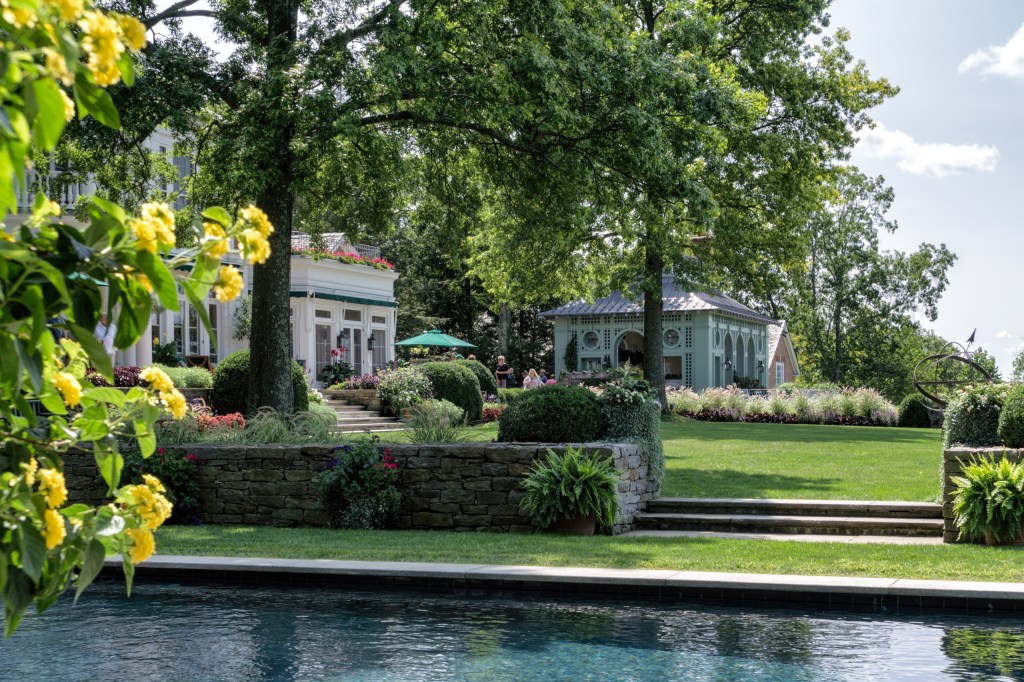
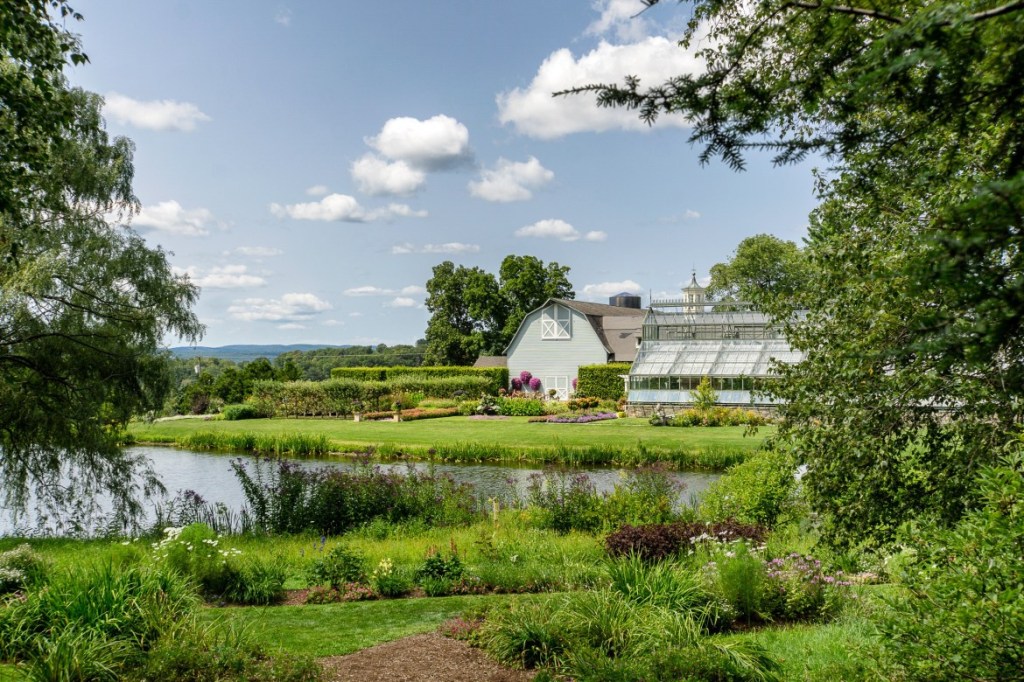
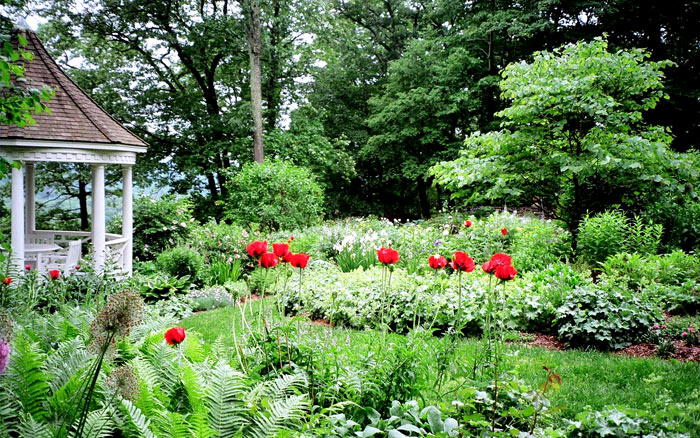
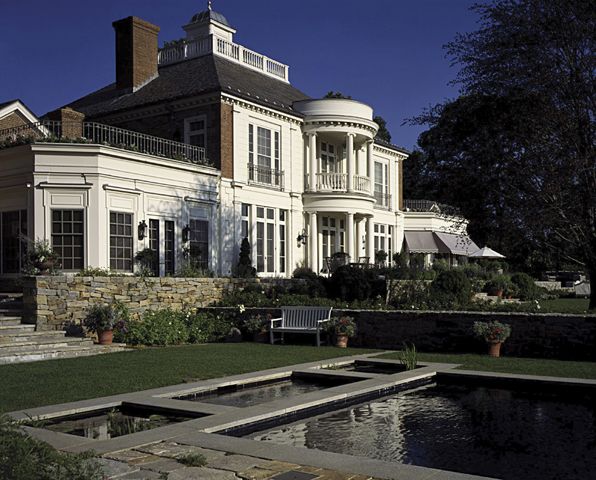
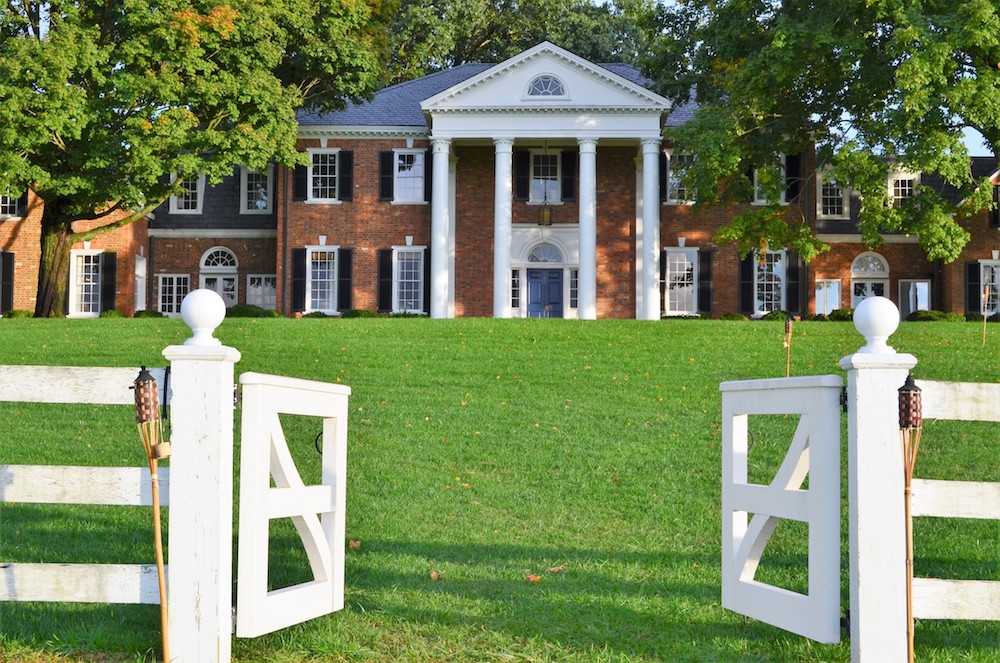
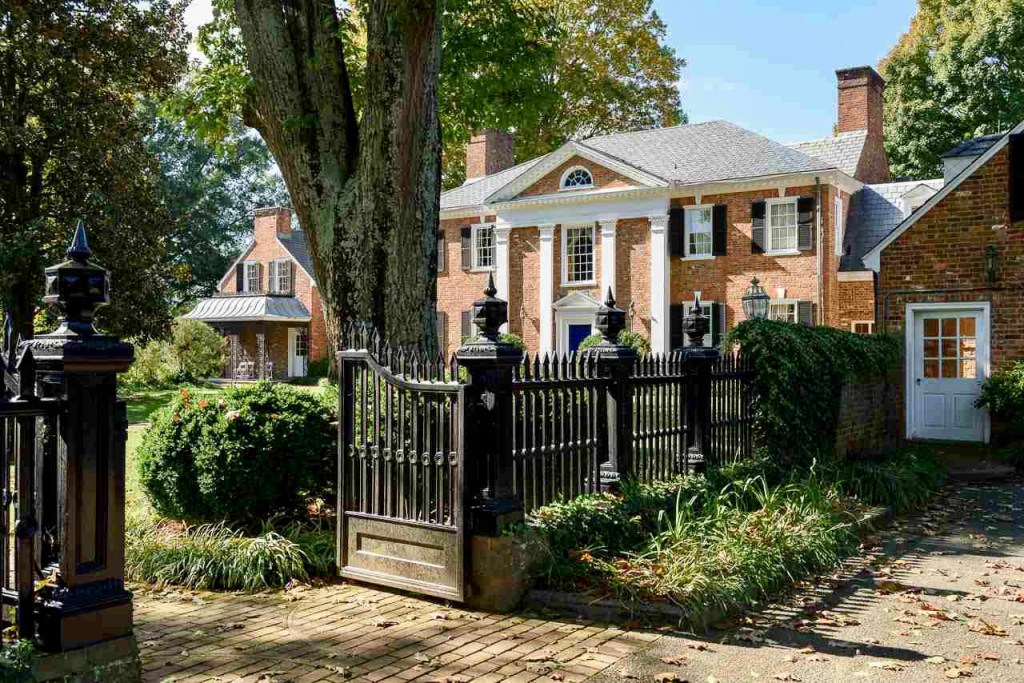
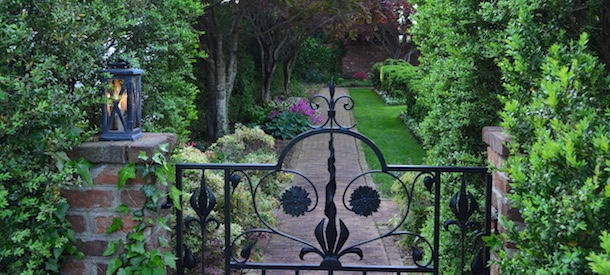
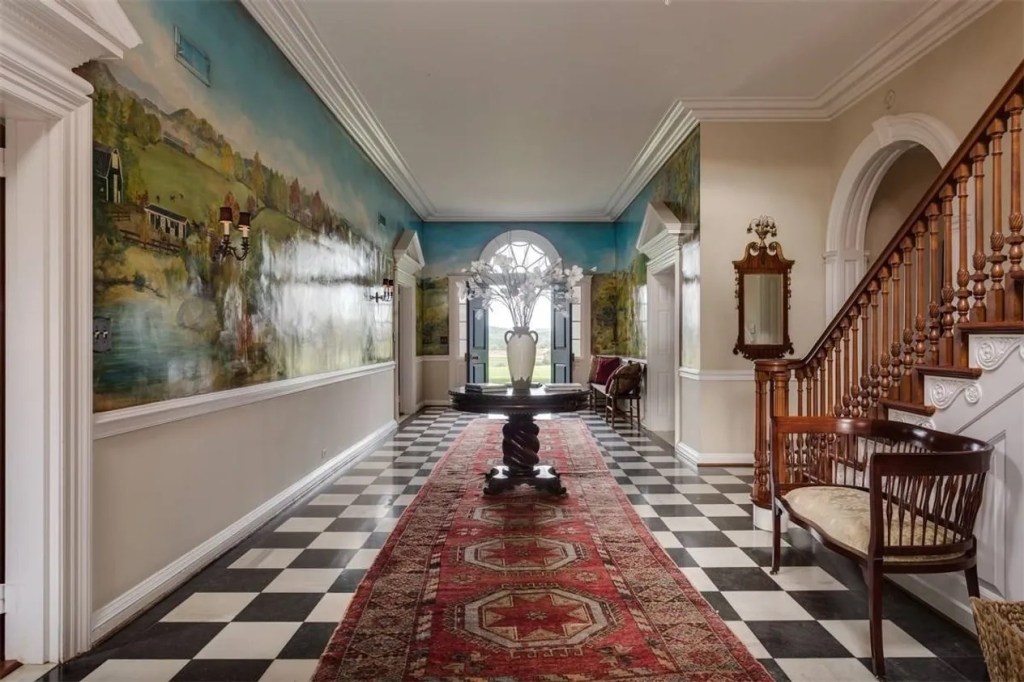
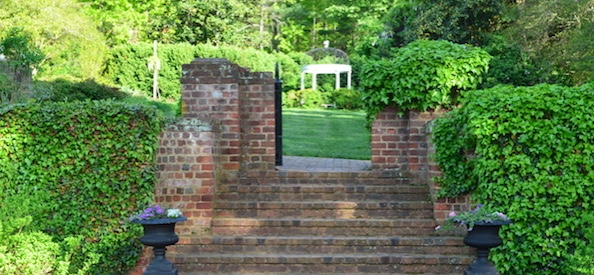
Maywood is a 50 acre estate outside Bridgewater, Connecticut in Litchfield County. The Georgian/neo-classical style home on the property was designed by the firm of Ferguson and Shamamian and completed in 2000 and is owned by Peter and Leni May. Peter has degrees from the University of Chicago and is a private equity investor along with partner, Nelson Peltz. Their firm, Triarc, has either had major share holdings in or been involved in restructurings of Snapple, Wendy’s, Pepsi Co., Family Dollar and several other major corporations. Maywood is also a working organic farm producing eggs, wines, produce, honey and maple syrup which can be bought at the Bridgewater Village Store. The house and gardens are not open to the public although the gardens are opened up one day per year with the proceeds benefitting the Garden Conservancy. For more information about Maywood, click here. A YouTube video showing the beautiful grounds can be viewed here.
Entrance frontGarden sceneGarden frontgarden sceneInterior sceneGarden front
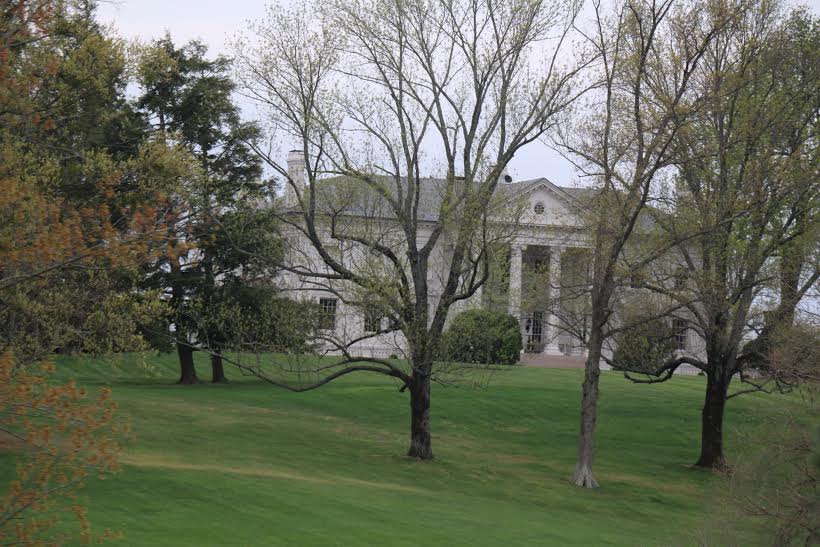
This house is Tiverton, a 19,000 square foot neoclassical mansion sitting on 460 acres in the hamlet of Greenwood, about 15 miles west of Charlottesville, Virginia. The property that would become Tiverton was purchased by Marie Ortman Boeing Owsley in 1900. Marie was originally from Austria and lived at Tiverton with her second husband, Dr. Frederic Dillard Owsley, a Chicago physician. The house was built by Frederic and completed in 1912. The identity of the architect is unknown. For some reason(s), between 1903 and 1919, Tiverton was sold, willed or transferred between members of the family multiple times. During this time period it was twice owned by Marie’s son from an earlier marriage, William Boeing, who would later go on to start Boeing Aircraft in Seattle.
Marie Ortman Boeing Owsley, the first owner of Tiverton
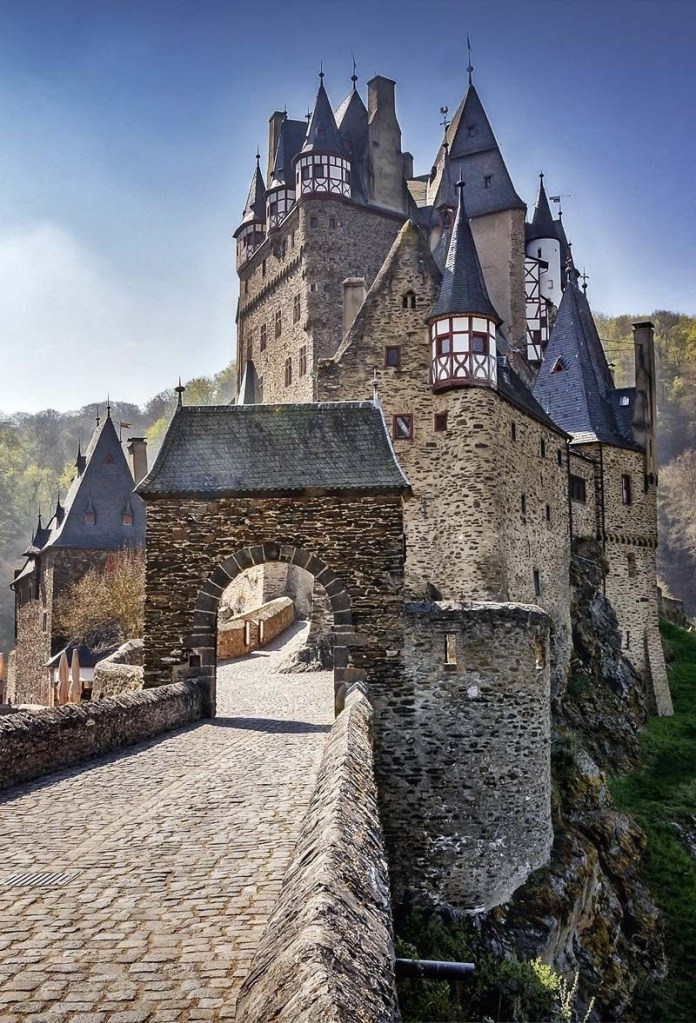
Marie died in 1910 and in 1919 the estate was bought outright by Frederic who by this time had also established a dairy operation at Tiverton. When it came to women, Frederic definitely had a type and that type was Austrian. In 1913, Frederic married another Austrian, Mariska Golgotzen, the Baroness Eltz from Vienna, Austria. The Eltz noble family originated in Germany in the 12th century and still has their seat at Burg Eltz, a castle on the Moselle River in Germany. In 1932, Tiverton was destroyed by fire leaving just the shell of the building. Frederic passed away the following year leaving the estate and burned out hulk to Mariska. The Baroness rebuilt Tiverton house to a similar design in 1935 using architect Carl Linder of Richmond. The formal gardens were redesigned by Virginia landscape architect Charles Gillette, who is renown for several gardens in the Old Dominion including a couple of country houses covered in this blog, Lochiel (click here) and Verulam (click here). One design element that the Baroness insisted on was a party room in the house complete with bar, dance floor and slot machines. The Baroness sold Tiverton in 1960 to Mike Hughey, a Florida businessman who owned gas stations. Mr. Hughey used it sparingly for the next 48 years and it slowly fell into disrepair, decay and weeds.
In 2008, Tiverton found a savior in Coran Capshaw. Mr. Capshaw had owned a bar in Charlottesville in the 1990s and signed up an unknown, local jam band to play in the pub. These unknown musicians called themselves the “Dave Matthews Band” and Mr. Capshaw has been managing them to worldwide fame ever since. He also owns a company that manages the careers and work of other musicians and artists such as Tim McGraw and Phish. He has also been involved in several property developments and renovations and owns several restaurants in Charlottesville. By the time he bought Tiverton, the house and grounds were in very poor condition but Mr. Capshaw embarked on extensive renovations (the second time for the house) and has brought the property back to life. The estate next door, Rose Hill, is also a looker and is covered in this blog (click here for more). Tiverton is a private home and is not open to the public.
Burg Eltz, the ancestral seat of the Eltz noble family
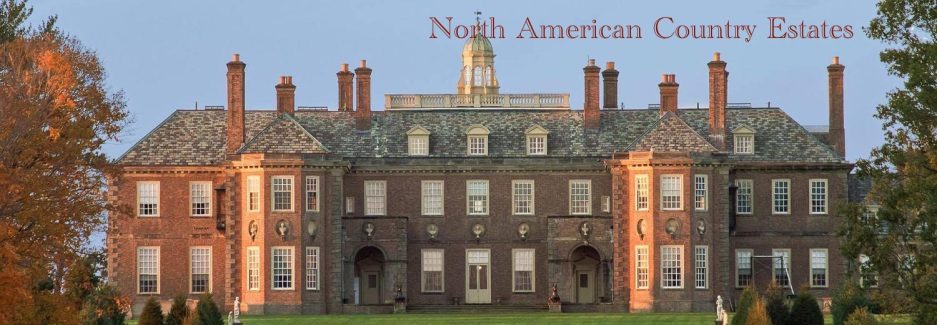
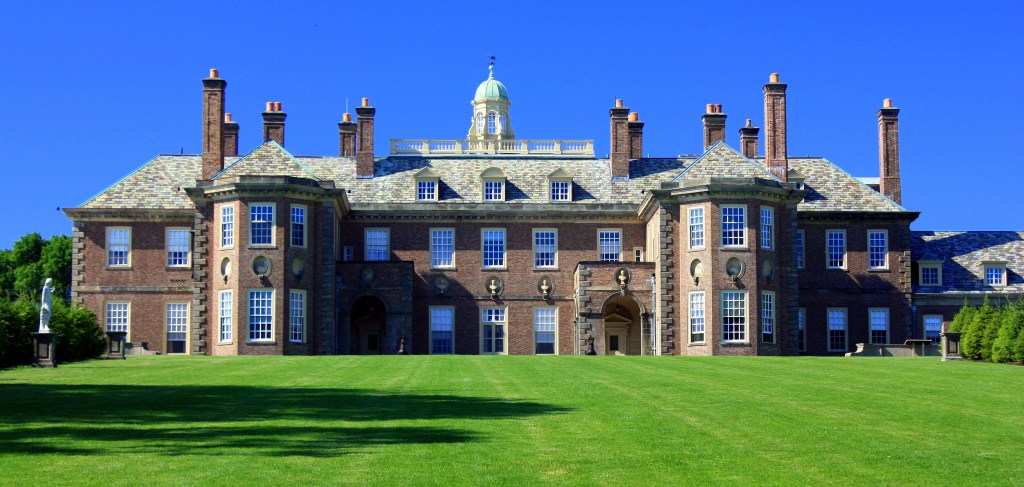
This Georgian revival stunner is the Crane Estate (AKA Castle Hill) and is located just outside Ipswich, Massachusetts. The house encompasses 57,000 square feet and is sited on a 2,100 acre estate. The house was designed by Chicago architect David Adler and the landscape, including the famous grand allee running down to the ocean, was designed by the Olmsted Brothers. For those unfamiliar with the term, an “allee” (pronounced AL-lay) is a design element used in a formal garden structure whereby a long, narrow expanse of lawn is lined by trees focusing the viewers attention on a distant feature such as a statue, a folly, a natural feature or the ocean in this case.
The house was built over three years and completed in 1928 by the son of the founder of the Crane Company famous for plumbing fixtures, Richard Crane, Jr., and his wife, Florence Higginbotham Crane. Richard had taken over as CEO of the company his father had founded back in 1855 and worked hard to achieve the Crane Company mission to “Make America want a better bathroom.” Florence’s father was a co-founder of the Marshall Field department store company in Chicago.
Garden front view from the grand allee
The current house is actually the second one to stand on the site. The Cranes bought the property in 1909 and built an Italian Renaissance-style house. Florence decided she didn’t like the house she called “the Italian fiasco” feeling that the architectural style didn’t fit the setting. She and Richard made a deal that if she still didn’t like it after ten years they would build something more to her liking. Ten years later Florence said she didn’t like the house so it was pulled down and the current house was built on the same foundation. You can catch glimpses of the first house in the sporting casino, located half way down the grand allee, which sports the Italianate design of the original house. The Cranes used the estate as their summer residence and lived most of the year in Chicago where the Crane Company was based.
The original Italianate mansion (AKA “the Italian Fiasco”) that preceded the current house. Pulled down in 1924.
Richard only got to enjoy the new house for three years before passing away in 1931. Florence lived on at the estate until her death in 1949 at which point it was deeded to The Trustees of Reservations, a non-profit organization which preserves and operates historic sites in Massachusetts. The Crane’s adult children, Cornelius Vanderbilt Crane (no relation to the Vanderbilts) and Florence Crane Jr. had rights as life tenants to continue to live in the guest house seasonally and use the property along with their families. The last resident was Cornelius’ second wife, Minescule ‘Mine’ Sawahara, who lived there until 1974. Both Crane children were adventurous spirits. Florence Jr. married writer William Robinson and they lived part-time in a one room house in Tahiti. Cornelius embarked on voyages to study the anthropological history of the South Pacific.
Fun facts about Cornelius and Florence, Jr.: Cornelius was the adoptive grandfather of SNL co-founder, actor and comedian Chevy Chase, who vacationed at the Crane Estate as a youth. In fact, Chevy Chase’s real name is Cornelius after his grandfather. Florence Jr. married a second time to the son of an exiled Russian aristocrat and became Princess Florence Belosselsky-Belozersky. Grigory Rasputin, the mad monk who helped to bring down the Russian Romanov dynasty was found dead floating in the Neva River in front of the Belosselsky-Belozersky family palace in St. Petersburg in 1916.
The builders of the Crane Estate, Richard and Florence Crane with their children, Cornelius and Florence Jr.
The Crane Estate is still owned and operated by The Trustees and the house and grounds are open to the public and are frequently used as a film location and a performing arts venue. Notable film credits include The Witches of Eastwick starring Jack Nicholson, Little Women starring Meryl Streep and Emma Watson and the reality TV series, The Amazing Race. Click here for information on visiting the Crane Estate. You can also stay at the former guest house on the estate – click here for more info on that. A YouTube video featuring some nice drone photography of the house and the grand allee can be seen here.
The Crane Estate has a connection to another beautiful country house covered in this blog. Richard Crane’s nephew, also named Richard Crane, bought and lived at the Westover Plantation in Virginia (click here).
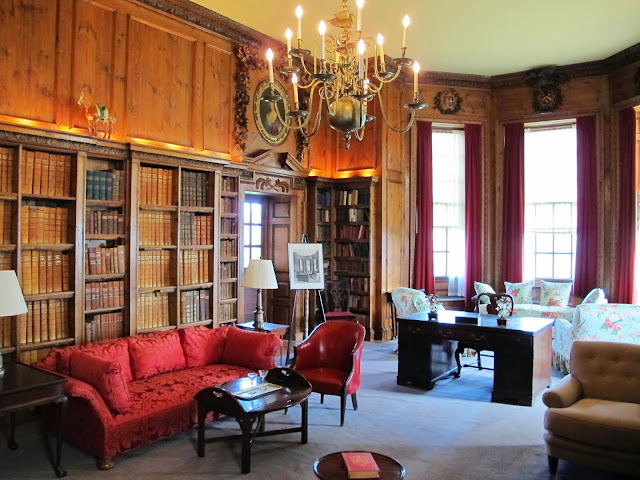
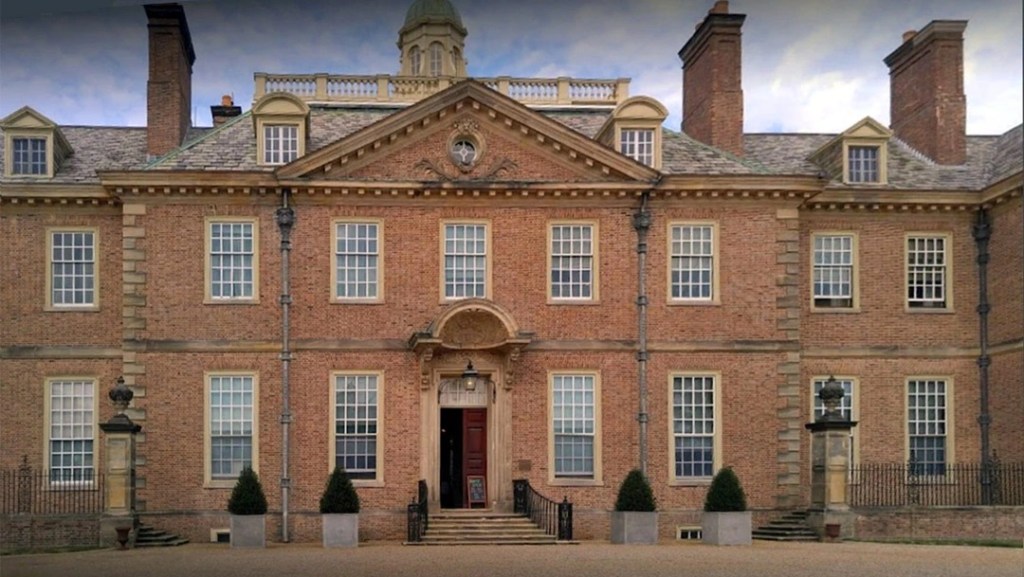
Aerial view showing the entrance front of the house and the famous grand allee lined by statuary, Norway spruce, white pine and red cedarGarden front of the house showing the sporting casino midway down the grand allee. The casino was built at the time of the original Italianate house and still shows that style of design.The libraryView of the gardensClose-up view of the entrance frontDetail from garden front
Hyde Park was the country estate of Frederick William Vanderbilt (1856-1938). Frederick was the grandson of “the Commodore”, Cornelius Vanderbilt, the steamship and railroad tycoon who was the richest person in the United States during the middle part of the 19th Century. Despite having little education, Cornelius built up a fortune of $105 million ($150-200 billion in today’s money depending on who’s counting). Cornelius had an insatiable love of money but spent very little on himself (or his long-suffering wives) and had a remarkable mind for numbers. He kept very few accounting records and managed his vast enterprise mostly in his own head. When Cornelius passed away in 1877 he left nearly everything to his eldest son, William Henry Vanderbilt. Cornelius had 13 children and considered all of them to be idiots but thought that William Henry might have some glimmer of hope. Despite this lack of confidence in his potential, William Henry proved to be a competent financier and railroad executive and doubled his inheritance before passing away in 1885. However, he was the last Vanderbilt to add to his inheritance rather than just spending it (Anderson Cooper may be the one exception). Although he enjoyed his fortune more than the Commodore did, William Henry’s Fifth Avenue house in New York was only a small sign of what was to come from the Vanderbilts.
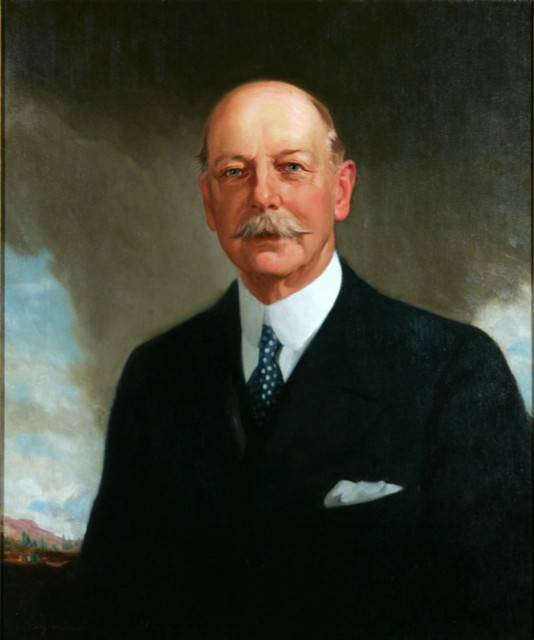
Frederick William Vanderbilt, the proprietor of Hyde Park
William Henry and his wife, Maria Louisa Kissam Vanderbilt, had nine children, eight living to adulthood. These eight children took their inheritances and cut loose, unleashing a deluge of home building that eclipsed anything that the royal houses of Europe had accomplished in such a short period of time. The houses either bought or built (nearly all built) by this generation of Vanderbilts is listed below:
That’s 32 mansions for 8 people (plus dependents) or four mansions per Vanderbilt. This is even more remarkable considering the size of these houses. Of the 25 largest homes ever built in the United States, six are on this list including the largest of them all, Biltmore, weighing in at 179,000 square feet. Biltmore is also the only one of these houses that is still owned by a Vanderbilt (though it is not used as a residence). Click here for more on Biltmore. Shelburne Farms is now a non-profit educational center, hotel and working farm focused on sustainability with Vanderbilt descendants still involved in the management.
Coffered ceiling in the dining room of Hyde Park
Emily Thorn Vanderbilt also built one additional notable house not on this list, High Lawn, for her daughter, Lila Vanderbilt Sloan. High Lawn is the only Gilded Age Vanderbilt mansion that is still lived in by a Vanderbilt and is covered in this blog (click here). Most of the houses on this list are either long gone, have been overrun by suburban development or, in the case of the Newport “cottages”, are really more of a luxury subdivision, not true country houses. But Hyde Park is unique in that it still retains the form of a country estate although it hasn’t been lived in for 83 years.
Hyde Park has been used as a country estate and retreat since the early 18th century when it was granted to Pierre Fauconnier in 1705 by the colonial Governor of New York, Edward Hyde, the Viscount Cornbury. In fact, the mansion we know as Hyde Park is the third house to stand on the site which is on a bluff overlooking the Hudson River and the Catskill Mountains to the west. In 1840 the estate was purchased by John Jacob Astor the Manhattan fur and real estate tycoon for his daughter, Dorothea. She and her husband, Walter Langdon, built the second house but soon afterwards Walter died and Dorothea moved to Europe. Her son, Walter Jr., took over in 1852 and expanded the estate to 600 acres. A few miles north of Hyde Park is Marienruh, another Astor house built in the 1920s.
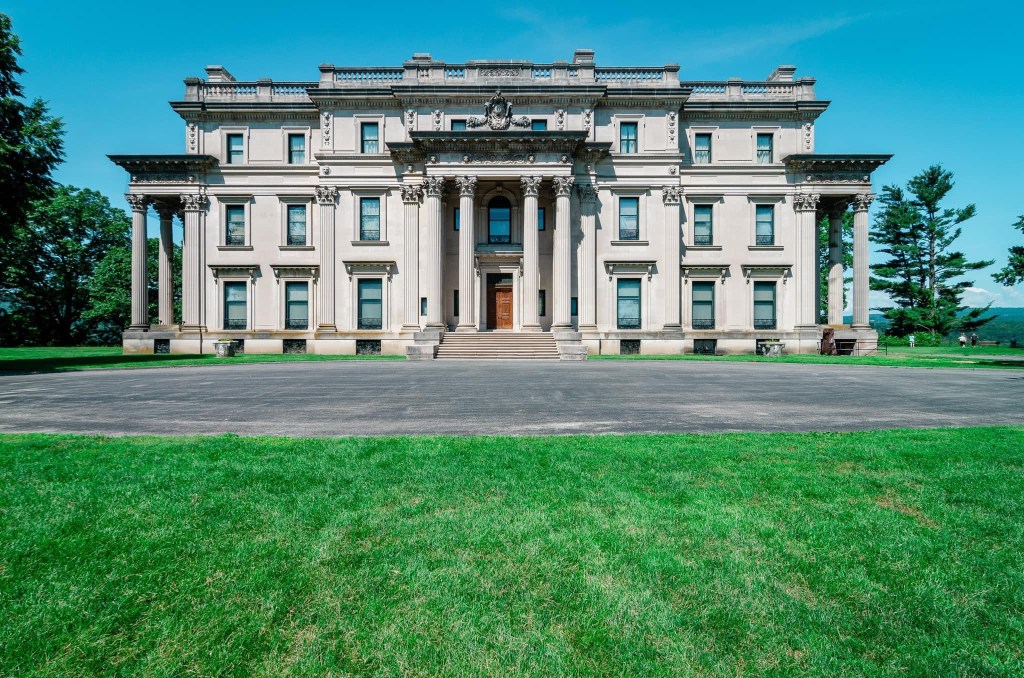
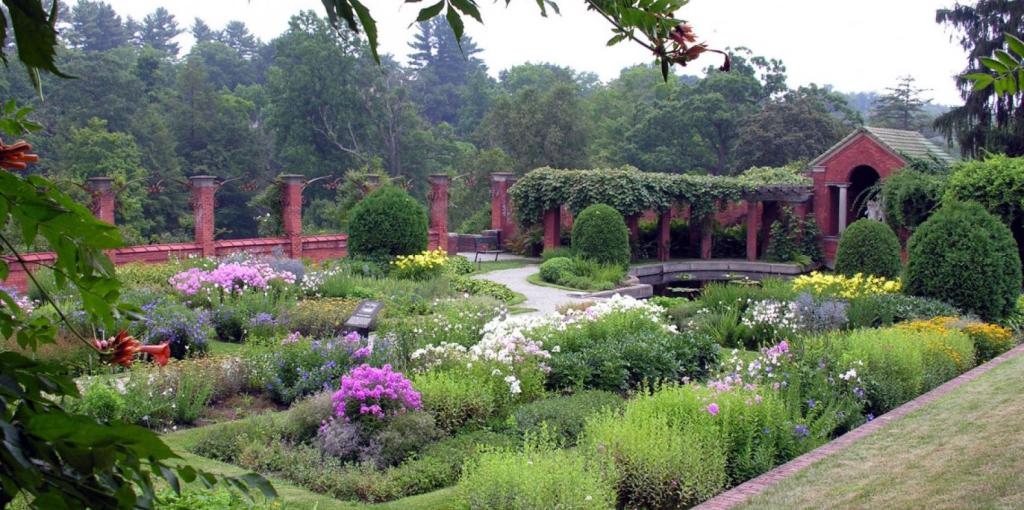
Walter Jr. died without heirs in 1894 and the estate was bought by Frederick William Vanderbilt and his wife Louise . Their initial inclination was to simply make additions to the Langdon house but their architect, Charles McKim of McKim, Mead and White, discovered severe dry rot in the structure and advised a complete rebuild. McKim designed the 50,000 square foot Neo-classical structure and construction was completed by 1899. The estate was attractive to the Vanderbilts for a couple of reasons. First, the railway that ran just below the house along the Hudson River happened to be the New York Central, which was the flagship of the Vanderbilt industrial empire. Frederick was a Director of the NY Central for 61 years although he did not pull rank when traveling between Hyde Park and New York City, preferring to sit in a regular coach rather than a private railway car as most gilded age millionaires would have done. Reserved and scholarly by nature, Frederick was the only one of his siblings to graduate from college, earning a degree from Yale University in Horticulture. He indulged his interest in horticulture at Hyde Park and devoted considerable attention to improving the landscaping that prior owners had installed at the estate. Frederick was responsible for developing the italianate formal gardens that still flourish today (thanks to the efforts of local volunteer-gardeners). The house itself was not universally admired. Some critics thought it more resembled a public library than a stately home and criticized its heavy and ponderous design elements. This didn’t seem to bother the Vanderbilts though. Of their many properties they seemed to prefer Hyde Park above the others.
On the grounds of Hyde Park
Louise Vanderbilt died in 1926 and this seemed to make the reserved Frederick even more shy. He lived as a virtual recluse at Hyde Park for the rest of his life, only seeing family and close friends, rarely speaking to the Hyde Park staff and spending his time puttering in the grounds and gardens. Frederick and Louise did not have children and when Frederick passed away in 1938 the house was left to Louise’s niece, Margaret “Daisy” Post. Daisy already had her hands full managing mansions in Newport and the south of France and wanted nothing to do with the cost and hassle of running Hyde Park as well but couldn’t find a buyer in the depths of the Depression so she approached the owner of a nearby estate, President Franklin D. Roosevelt, for advice. FDR grew up and still resided part of the year at his ancestral estate of Springwood a couple miles south of Hyde Park and he had been an occasional guest of the Vanderbilts at Hyde Park. It was FDR who suggested donating the estate to the National Park Service and opening it up to the public. Daisy agreed and by 1940, Hyde Park was open to the public (except when FDR was staying at Springwood when his aides and secret service detail would temporarily take up residence at Hyde Park).
Formal gardens at Hyde Park
If you want to visit Hyde Park, it can be reached by car or train (transferring to a bus in Poughkeepsie) from either Albany or New York City. Additional information can be found here. Leave time in your schedule for visiting nearby Springwood, the home of FDR. In addition to the final resting place of FDR and Eleanor Roosevelt, Springwood has educational and quite moving exhibits about the life and times of FDR and the challenges the the country faced during the Great Depression and the Second World War. Info regarding Springwood can be found here. Finally, almost directly across the Hudson River from Hyde Park is another notable country estate, Omega, covered in this blog (click here).
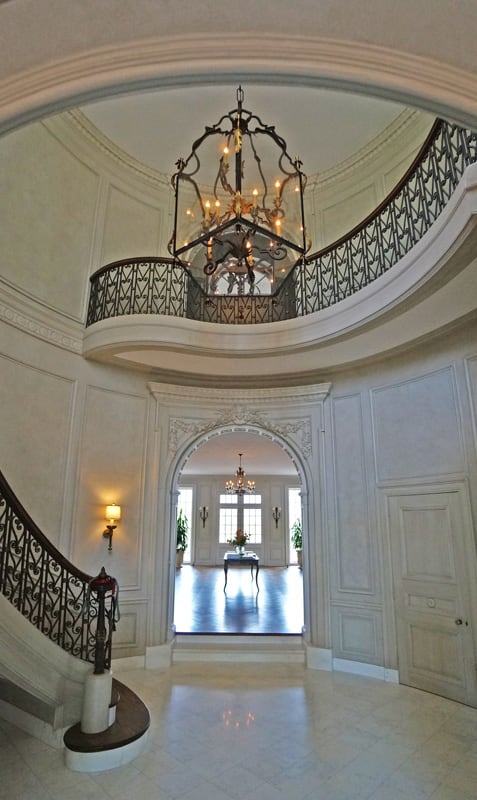
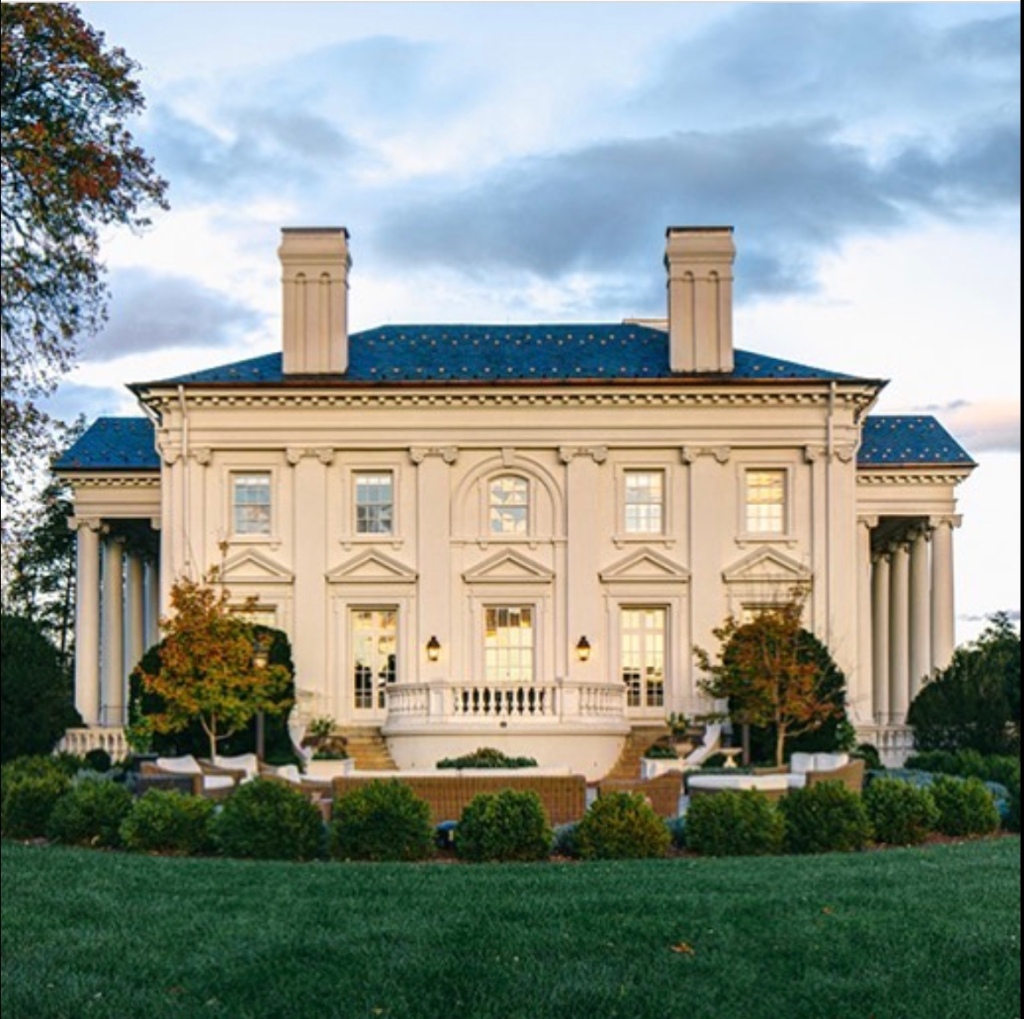
Verulam (VAIR-u-lem) is a 12,000 square foot Georgian-revival manor house sited on a 500 acre estate of the same name a few miles west of Charlottesville, Virginia. The house was the creation of New York attorney Courtland Van Clief and his wife, Eleanor. Courtland descended from Virginia horse country gentry and Eleanor’s family was involved in the lumber business in Waco, Texas. The Van Cliefs retained the Virginia-based architect Marshall Wells and landscape designer Charles Gillette to design the house and grounds. Mr. Gillette was particularly renown for developing a formal style of garden that well-suited and accentuated the Georgian, colonial and neo-classical homes dotted around Virginia. Other examples of his work can be found at Lochiel (also covered in this blog here) and Tiverton (click here). Verulam was completed in 1946 and the Van Cliefs lived here and raised thoroughbred horses until 1962 when Courtland passed away.
Courtland and Eleanor made national headlines during their 1929 wedding in Buffalo, New York when nine armed robbers crashed a pre-wedding dinner at gunpoint and stole everyone’s jewelry and cash making off with $400,000 in loot. In news reports of the time the wedding guests chalked up the robbery to “dope fiends” which just shows that things haven’t changed much since the 1920s. The Van Cliefs were no strangers to nice houses. Courtland’s brother, Ray, bought and renovated the Rosecliff mansion in Newport, Rhode Island but was killed in an auto accident on his way to have dinner and spend his first night at the newly refurbished mansion.
The next proprietors of Verulam were John and Jane “Kitchie” Ewald. John and Kitchie met while they were both working for the Virginia Youth for Eisenhower in 1952. John was well schooled at Phillips Exeter Academy, Yale University and the University of Virginia Law School. Kitchie also attended law school at Georgetown University. The two legal eagles bought the estate in 1969 and, like the Van Cliefs, the Ewalds raised thoroughbred horses at Verulam and were well regarded in the Charlottesville community for their Christmas and children’s parties. During this time, Interstate 64 was completed through this section of Albemarle County effectively splitting up the Verulam estate and reducing its size from 1,700 acres to the present 500. Unfortunately, I-64 now drones away less than a quarter mile from Verulam.
John Ewald passed away in 1979 and Kitchie remarried in 1982 and then sold Verulam in 1986 to Peter Nielsen. Mr. Nielsen was a part-time resident and gentleman farmer who was in the software business. He, in turn, sold Verulam in 2002 to Melton McGuire and his wife, Heather. The McGuires were in the microbrewery business in Alexandria and raised Friesian horses at Verulam, worked at restoring the gardens and developed a party barn on the property to host weddings and other events. At some point, the McGuires split up but Melton stayed on a Verulam until 2021 when he tragically passed away at age 57. Verulam was then on the market for a few years finally selling for $6 million in February 2024 to a local attorney. An upbeat YouTube video showing scenes from Verulam can be viewed here.
Footnote: The ring leader of the wedding party armed robbery was a Canadian named George Duke. Rather than a “dope fiend,” Mr. Duke was just a common criminal on the run from Canadian authorities. Mr. Duke and the rest of the robbers were caught and Duke spent 12 years in prison and was then deported back to Canada. Apparently scared straight, he found work as a lawnmower salesman, got married and eventually built up a major lawn mower distribution company in Ontario and grew wealthy enough to build a lakefront house near Toronto. Alas, the temptations of easy money, booze, guns and whoring were too strong to resist and Duke was eventually involved in the infamous heroin smuggling operation known as the French Connection that was later the subject of an Oscar-winning movie starring Gene Hackman.






















 North American Country Estates