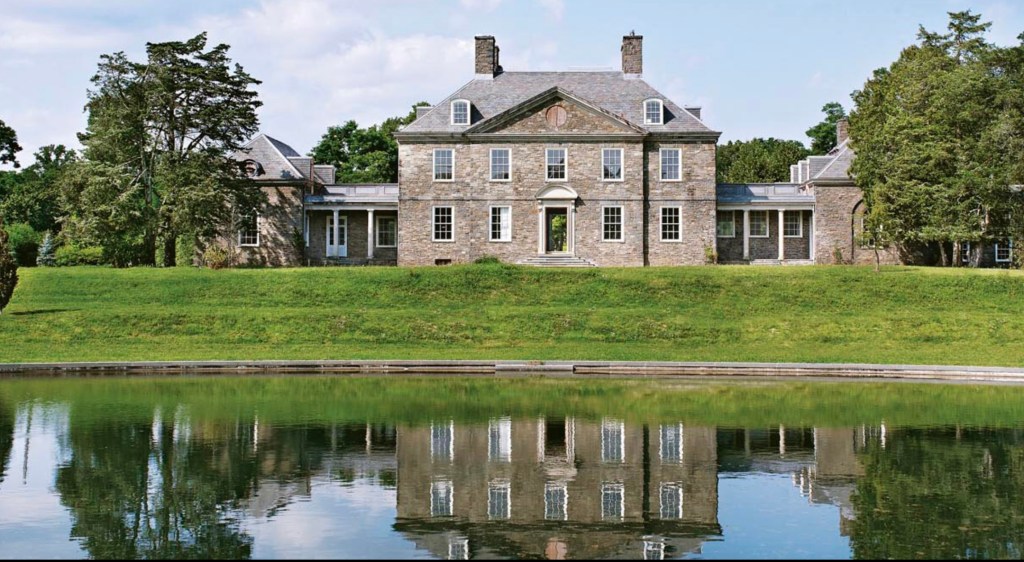
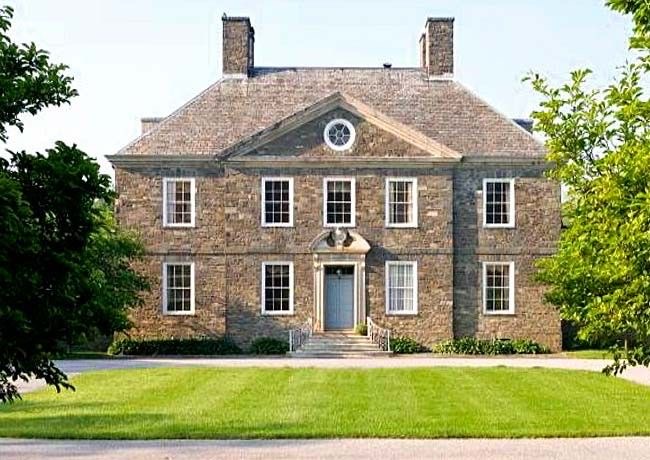
This beautiful Palladian/Georgian-revival house is known as Marienruh (MARY-en-roo). It is sited on a 100 acre estate north of the bucolic village of Rhinebeck, NY overlooking the Hudson River. It was designed by the gilded age architect Mott Schmidt and completed in 1926. The house was a wedding present from Vincent Astor to his sister, Ava Alice Muriel Astor (who went by Alice), and her new husband, Prince Serge Obolensky. Alice was the great great granddaughter of John Jacob Astor. Astor was the first American multi-millionaire (tens of billions in today’s money) who grew rich in the early 19th century fur trade, with his agents often trading liquor to the natives for furs. Blessed with amazing foresight, Astor plowed his fur profits into Manhattan real estate (mostly woods and farms back then) and became even wealthier as these lots were converted into tenements housing the immigrants that flooded into New York City during the 19th century. On his deathbed, Astor’s only regret was that he hadn’t bought up even more of Manhattan Island. His descendants were prominent members of New York City society during the 19th and 20th century. In the early 1890s, as a result of a feud between two of the female Astors over who was more important socially, a branch of the Astor family decamped to England and has been turning out aristocrats and prominent politicians in the UK ever since. The American branch of the Astor family, in contrast, has faded into relative (but comfortable) obscurity.
Marienruh was on the grounds of the larger Astor estate, called Ferncliff Farm, that was established by Alice’s grandfather in the 1850s. In the 19th century, Astor estates and homes sprawled along the left bank of the Hudson between Rhinebeck and Barrytown (where they transitioned to the Livingston family estates that went even further north – click here for more on the Livingston estates). One such Astor estate, Rokeby, is still owned by Astor descendants.
At one time, Ferncliff was 2,800 acres but after the death of Alice’s brother, Vincent Astor, the estate was parceled out with a portion becoming a forest preserve, another portion becoming a nursing home and other portions converted to private residences. Chelsea Clinton was married at Astor Courts, a one-time sports pavilion on the estate. Another portion of the former Ferncliff estate is the home of famous photographer Annie Leibovitz.

Alice Astor’s father was John Jacob Astor IV, who perished with the Titanic in April 1912. Initially, he was unperturbed about the ship striking an iceberg and was last seen having a smoke on the starboard side, a half hour before the ship disappeared beneath the waves. Afterwards, Alice was raised in England by her mother. Alice was a bit of an eccentric and claimed that she was the reincarnation of an ancient Egyptian princess. To bolster her claim, she often wore a necklace that had been among the treasures found in the tomb of Pharaoh Tutankhamun.

Alice’s husband, Prince Serge Obolensky, wasn’t a real prince of the Romanov dynasty that ruled Russia for three centuries although he was descended from another princely dynasty that preceded the Romanovs. Instead, he was married for a few years to an illegitimate daughter of Tsar Alexander II, Princess Catherine Alexandrovna Yurievskaya, before his marriage to Alice. A raconteur and bon vivant of the first order, Prince Serge was tall, handsome, smart, charming and a good dancer.
Prince Serge and Alice met at a costume ball in London where he was working as a stockbroker. Initially, Alice’s mother objected to her marrying what she considered to be a penniless, exiled Russian prince but Alice soon turned 21 and married him anyway. She and Prince Serge had three weddings in England: an Anglican ceremony, a civil ceremony, and a third in a Russian Orthodox cathedral. After honeymooning in France they began their married life of yachting, posh hotels and first class travel.

Apparently, Prince Serge’s charm and dancing skills failed to keep the spark alive and he and Alice divorced in 1932 after just eight years of marriage (seven if you subtract the extra-marital affairs – on both sides). After the divorce, Alice kept Marienruh and she remarried three times: 1) an Austrian writer, 2) an English writer, and 3) an English architect. She died single in 1956 at age 54 from a stroke. She was a patron of the arts during her life and was a big supporter of the New York City Ballet company.

Although Prince Serge’s history with Marienruh was brief, his post-divorce life merits a mention. He volunteered for service in World War II and was part of the Office of Strategic Services (OSS), the forerunner of the CIA. In that role, he parachuted into Sardinia and France on missions at the age of 54. Postwar, he had a long and successful career in the New York hotel business and was a high-class lounge lizard in Manhattan, squiring around and dancing with the likes of Jackie Onassis and actress Joan Fontaine. Legend has it that he invented everyone’s favorite hangover cure, the bloody mary. He passed away in 1978 while wearing black tie, holding a martini and chatting up the nurses (I’m guessing).

After Alice Astor’s death, Marienruh was sold and used variously as a church camp, a home for unwed mothers, a drug rehab center and an event center. The home, by then in very poor condition, was purchased in 2006 for $7 million by a writer and Columbia University professor. The new owner has been restoring Marienruh to its former glory ever since. Marienruh serves as a private home and is not open to the public however another country estate covered in this blog is just a few miles south in Hyde Park. Frederick Vanderbilt’s Hyde Park estate (click here) is open to the public as is Springwood, the nearby home of FDR.
 North American Country Estates
2 thoughts on “Marienruh”